
Views: 0
BIN3AIAH FISHES | WILDLIFE & MARINE LIFE
Great White Shark: The Ocean’s Apex Predator


9
Marine Wildlife
Sharks
Conservation
The great white shark (Carcharodon carcharias) is one of the ocean’s most powerful and recognizable predators. With its streamlined body, remarkable senses, serrated teeth, and ability to travel thousands of kilometres, this extraordinary animal has evolved into a highly effective hunter.
Despite its fearsome reputation in movies and popular culture, the great white shark plays an essential role in maintaining healthy marine ecosystems. Understanding its biology and behaviour reveals a fascinating creature that deserves both respect and protection.
Great White Shark: Quick Facts
| Scientific name | Carcharodon carcharias |
| Family | Lamnidae |
| Maximum length | Approximately 6.4 m (21 ft) |
| Weight | Over 2,000 kg in very large individuals |
| Lifespan | Potentially 70+ years |
| Diet | Fish, rays, seals, sea lions, and carrion |
| Habitat | Temperate and subtropical oceans |
| Conservation status | Vulnerable (IUCN) |
Size and lifespan figures are approximate and vary by individual and research method. Sources: NOAA Fisheries and the Convention on Migratory Species.
NOAA Fisheries
+1
1. Anatomy: Built for the Hunt
The great white shark’s body combines strength, speed, and efficiency.
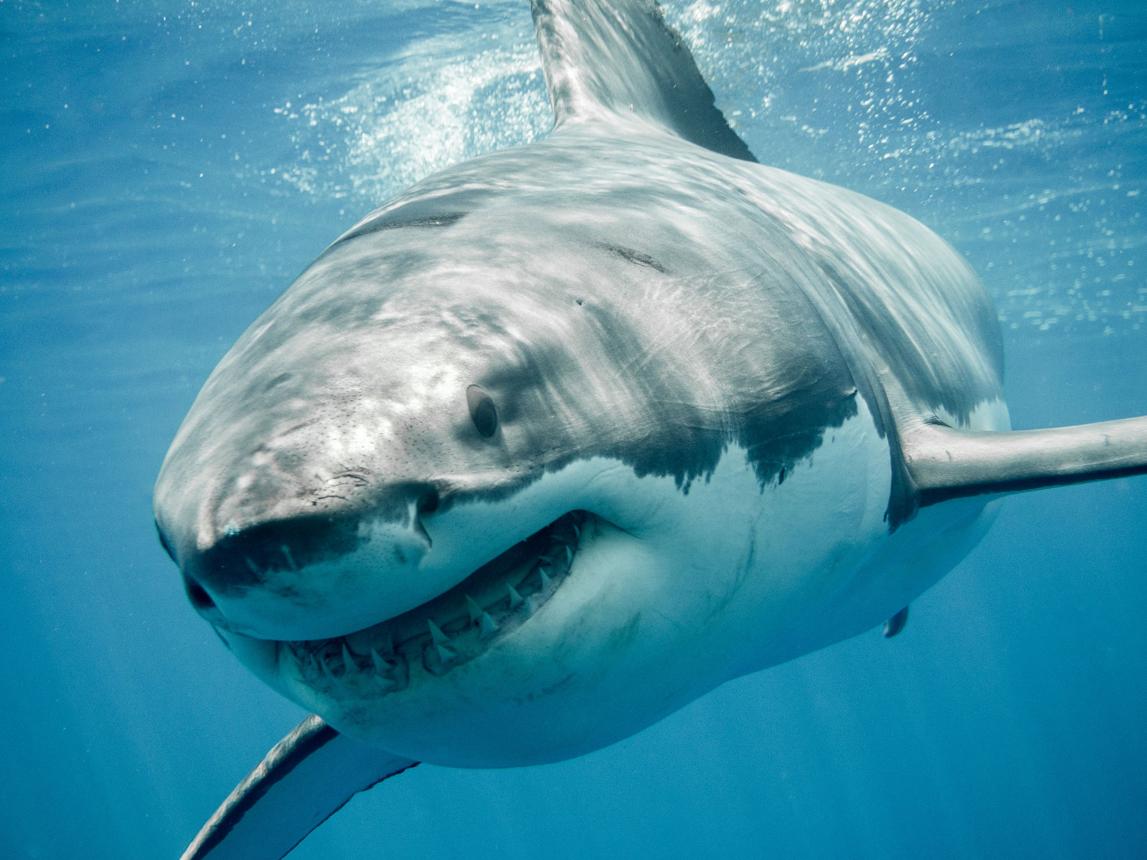
Its torpedo-shaped profile reduces resistance while swimming. A powerful crescent-shaped tail provides propulsion, while broad pectoral fins help stabilize movement.
Its coloration is equally important. The grey upper body blends with the darker water below when viewed from above, while the pale underside blends with sunlight when viewed from below. This natural camouflage is known as countershading.

The shark’s jaws contain multiple rows of triangular, serrated teeth designed to grip and cut prey. Teeth are replaced throughout its life, keeping the animal equipped to feed effectively.
Unlike most fish, great white sharks also possess regional endothermy, allowing important parts of their bodies to remain warmer than the surrounding seawater. This supports powerful swimming and effective hunting in cooler environments.
NOAA Fisheries
+1
2. Diet and Hunting Techniques
Great white sharks change their feeding habits as they grow.
Young sharks primarily consume fish, smaller sharks, rays, and squid. Larger individuals can hunt marine mammals, especially seals and sea lions, while continuing to eat fish and opportunistically feeding on whale carcasses.


8
One of their most dramatic hunting methods is an upward ambush. A shark approaches from below, where its darker body is difficult for prey to distinguish, and accelerates toward an animal near the surface. Some attacks are powerful enough to propel the shark partly or entirely out of the water, a behaviour known as breaching.
Great whites are not simply aggressive eating machines. They are adaptable predators that assess prey, respond to their environment, and use multiple hunting strategies.
3. Extraordinary Senses
A great white shark relies on an impressive combination of sensory abilities.
- Smell: Detects chemical signals carried through seawater.
- Vision: Helps identify movement, shapes, and contrasts.
- Hearing: Responds to low-frequency underwater sounds.
- Lateral line: Detects water movement and vibrations.
- Electroreception: Specialized organs called ampullae of Lorenzini detect weak electrical fields produced by other animals.
These abilities make the great white shark especially effective at locating prey, even when visibility is limited.
Smithsonian Ocean
+1
4. Where Great White Sharks Live

Great white sharks inhabit coastal and offshore waters across many parts of the world. Important regions include California, Mexico, South Africa, Australia, and New Zealand.
They are highly migratory and may travel enormous distances between feeding areas, offshore habitats, and potentially reproductive regions.
Scientists use satellite and acoustic tags to study these journeys and better understand how sharks use different marine habitats throughout their lives.
5. Reproduction and Life Cycle
Great white sharks give birth to live young rather than laying eggs externally.
Their reproduction is slow compared with that of many other fish. NOAA reports that males may not reach sexual maturity until approximately 26 years of age, while females may mature at around 33 years.
Because great whites take many years to mature and produce relatively few offspring, their populations can recover slowly from excessive fishing mortality.
NOAA Fisheries
+1
6. Are Great White Sharks Dangerous to Humans?
Great whites are capable of seriously injuring humans, and encounters should always be treated with caution. However, humans are not a normal part of their preferred diet.
Some bites are associated with investigation or mistaken identification, but the motivations behind individual incidents cannot always be established.
Responsible ocean recreation includes following local shark advisories, avoiding areas where sharks are actively feeding, and never attempting to approach or touch a wild shark.
7. Their Importance to the Ocean
As apex predators, great white sharks influence marine food webs through predation and their effects on prey behaviour.
They help shape interactions among marine animals, although their precise ecological impacts vary between ecosystems.
Protecting sharks is therefore not simply about preserving a famous species. It also contributes to safeguarding the ecological relationships that support healthy oceans.
8. Conservation: Protecting a Vulnerable Predator

The great white shark is classified as Vulnerable by the IUCN.
Major threats include accidental capture in fishing gear, targeted fishing, habitat pressures, and entanglement in nets.
Protective measures include fisheries regulations, international trade controls, migration research, and improved fishing practices that reduce accidental captures.
Sharks
+1
9. Fascinating Great White Shark Facts
- Great whites are among the largest living predatory fish.
- They can maintain certain body tissues warmer than seawater.
- Their teeth are continually replaced.
- Some individuals undertake transoceanic migrations.
- Their electrical sensing organs can detect very weak signals.
- Females generally grow larger than males.
- Some individuals may live longer than 70 years.
- Juveniles and adults often eat different kinds of prey.
- Their grey-and-white colouring provides natural camouflage.
- Their conservation is important because reproduction is slow and fishing-related deaths can have lasting effects.
Conclusion
The great white shark is much more than the terrifying creature often portrayed on screen. It is a sophisticated, long-lived predator with exceptional biological adaptations and a valuable place in marine ecosystems.
Through scientific research, responsible fisheries management, and better public understanding, we can help ensure that future generations continue to share the oceans with this remarkable animal.
Publisher Media Package
Prepared for fishes.bin3aiah.net
Photo gallery — 10 images
The Wikimedia Commons great white shark library includes photographs suitable for building a 10-image gallery, subject to checking each file’s licence and attribution requirements.


10
Featured image recommendation: A horizontal underwater photograph showing the shark’s full head and body with open blue water around it, leaving space for cropping on mobile and desktop.
The images above are visual references, not yet a rights-cleared WordPress gallery.
Three documentary videos

1. Great White Shark Attack and Breach
BBC Earth · Hunting and breaching behaviour

2. It’s a Shark Eat Shark World
Nat Geo Animals · Shark predation research
National Geographic · Shark hunting footage
SEO and WordPress Details
| Field | Recommended value |
|---|---|
| Post title | Great White Shark: The Ocean’s Apex Predator |
| Post ID | FISHES-004 (proposed) |
| Slug | great-white-shark-ocean-apex-predator |
| Focus keyword | great white shark |
| Secondary keywords | great white shark facts, shark habitat, shark diet, shark conservation |
| Category | Sharks |
| Meta description | Discover the great white shark’s size, powerful hunting skills, ocean habitat, fascinating biology, and why this apex predator needs protection. |
| Featured image alt text | Great white shark swimming underwater in the open ocean |
| Schema | Article + FAQPage, where eligible |
Suggested FAQ questions: How big is a great white shark? What does it eat? Where does it live? How long does it live? Why is it vulnerable?
Scientific references: NOAA Fisheries, Smithsonian Ocean, and Convention on Migratory Species.
Article drafted
Publication: Not yet published
The article, SEO metadata, photo sources, and documentary links are prepared for the Bin3aiah Fishes publishing workflow. Actual image licensing, uploads, WordPress formatting, and live publication remain outstanding.