
Views: 3
Coelacanth: The Ancient Fish Rediscovered in Modern Times
For millions of years, coelacanths were known to scientists only through fossils. These remarkable lobe-finned fishes were believed to have disappeared from the world’s oceans around the end of the Cretaceous Period, approximately 66 million years ago. Then, in 1938, an extraordinary discovery proved that members of this ancient lineage were still alive.

The Remarkable Rediscovery of 1938
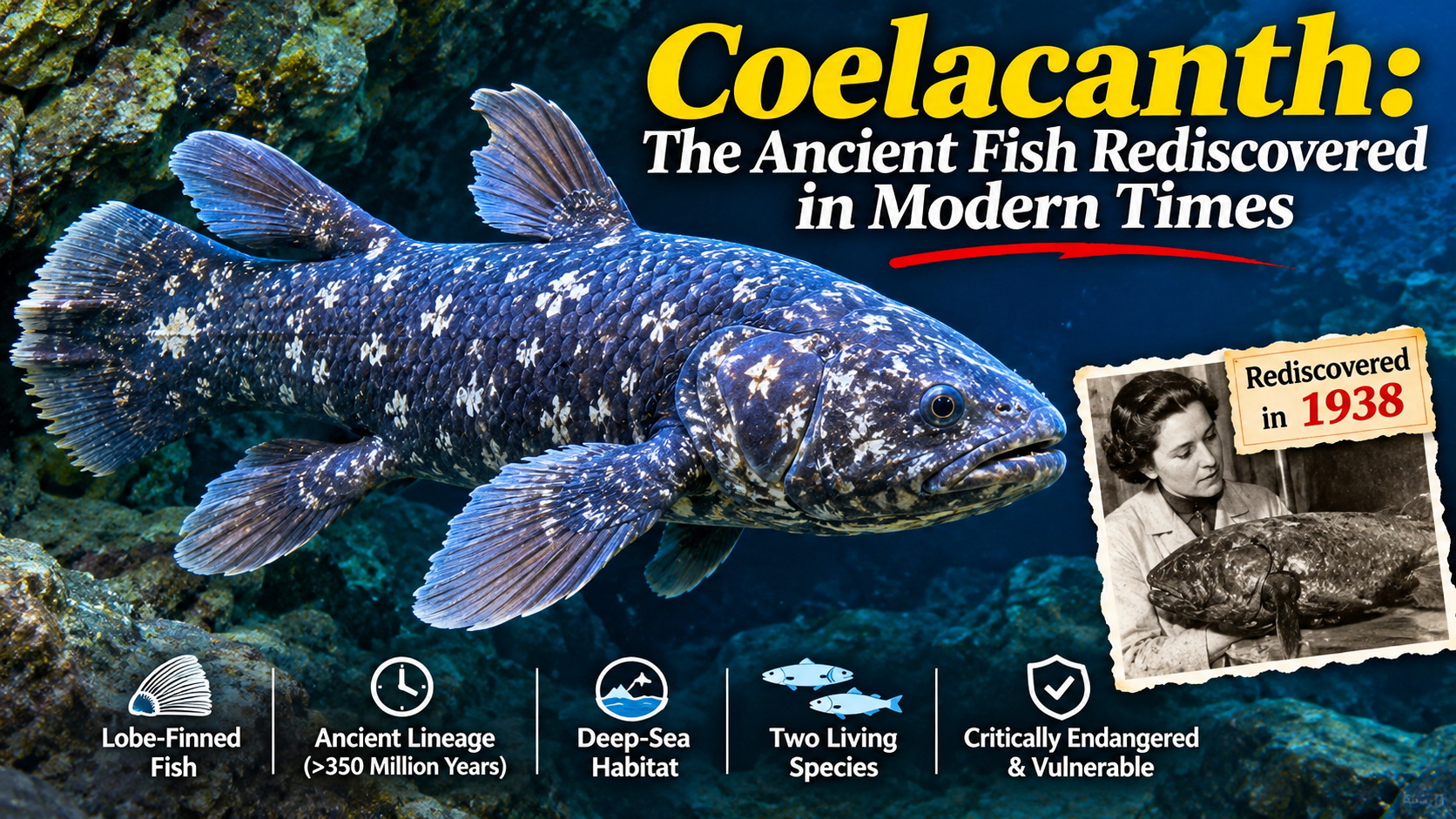
On December 22, 1938, a fishing trawler brought an unusual fish to East London, South Africa. Marjorie Courtenay-Latimer, curator of the local museum, immediately recognized that the strange specimen deserved scientific attention.
She contacted ichthyologist J. L. B. Smith, who subsequently identified the fish as a coelacanth. The species was named Latimeria chalumnae, honoring Courtenay-Latimer and the Chalumna River region.
The discovery astonished scientists because coelacanths had previously been known from the fossil record, with no recognized living examples. Another specimen was documented in the Comoros in 1952, helping researchers investigate the species’ distribution.

What Makes the Coelacanth So Unusual?
Coelacanths belong to the lobe-finned fishes, a lineage with an evolutionary history extending back more than 400 million years. Unlike most familiar fishes, they possess paired fleshy fins supported by internal bones.
These fins move in a coordinated, alternating pattern that has fascinated scientists studying the evolution of vertebrate limbs.
Other remarkable features include:
- Lobed fins: Fleshy, internally supported fins that help the fish maneuver through deep water.
- Intracranial joint: A specialized skull joint that allows movement between parts of the head.
- Three-lobed tail: An unusual tail structure with a small central lobe.
- Electrosensory organ: A rostral organ that can detect weak electrical signals from surrounding animals.
- Thick scales: Durable scales protecting the fish’s elongated body.
- Live birth: Females give birth to developed young after an extended period of internal development.

Two Living Species of Coelacanth
Scientists currently recognize two living coelacanth species.
West Indian Ocean Coelacanth
Latimeria chalumnae inhabits portions of the western Indian Ocean, including waters around the Comoros and parts of the eastern African coastline. It typically has bluish-gray coloring with pale spots.
Indonesian Coelacanth
Latimeria menadoensis was recognized following discoveries near Sulawesi, Indonesia, in the late 1990s. It generally has a browner appearance. Its discovery dramatically expanded the known geographical distribution of living coelacanths.

Where Do Coelacanths Live?
Coelacanths inhabit deep marine environments, often around 150–250 metres beneath the surface. They favor underwater caves, rocky slopes and sheltered formations where relatively cool water provides suitable conditions.
During daylight hours, coelacanths may remain relatively inactive inside caves. At night, they move into surrounding waters to search for food, including smaller fishes and cephalopods.
Their slow movements and specialized habitat make these animals difficult to observe. Scientists have relied on submersibles and specialized underwater equipment to study their natural behavior.
How Long Can Coelacanths Live?
Research suggests that coelacanths are exceptionally long-lived. Studies of growth markings on their scales indicate that they may survive for approximately a century.
They also appear to grow and reproduce slowly. Research suggests that their pregnancies may last approximately five years, making their reproductive biology particularly unusual among vertebrates.
These characteristics make coelacanth populations vulnerable to the loss of breeding adults.
Are Coelacanths Really Living Fossils?
Coelacanths are frequently called living fossils because their overall body structure resembles ancient fossil relatives. However, this description does not mean that modern coelacanths are identical to their prehistoric ancestors.
They have continued to evolve, just like other living organisms. Their importance lies in their evolutionary relationships and the opportunity they provide to study characteristics of ancient lobe-finned fish lineages.
Although coelacanths are related to the broader group from which land vertebrates evolved, they are not direct ancestors of modern amphibians, reptiles, birds or mammals.
Conservation: Protecting an Ancient Survivor
Despite surviving major events in Earth’s history, living coelacanths face conservation threats today.
The West Indian Ocean coelacanth is classified as Critically Endangered, while the Indonesian coelacanth is classified as Vulnerable on the IUCN Red List.
Accidental capture by fishing gear is an important concern, especially because their slow reproductive cycle may limit population recovery. Habitat protection, scientific monitoring and responsible fisheries management are essential conservation measures.

Why the Coelacanth Still Fascinates Scientists
The rediscovery of the coelacanth demonstrated that even scientifically familiar evolutionary histories can contain surprises. An animal known for generations through fossils was suddenly revealed to be living in the modern ocean.
Today, researchers investigate its anatomy, genetics, development and deep-water ecology to better understand vertebrate evolution and marine biodiversity.
The coelacanth’s survival serves as a powerful reminder that Earth’s oceans still hold extraordinary biological discoveries.
Conclusion
Few fish have changed scientific understanding as dramatically as the coelacanth. Rediscovered in 1938 after millions of years without recognized living specimens, this ancient fish continues to reveal insights into evolution, survival and life beneath the ocean’s surface.
Protecting the two living coelacanth species means preserving a remarkable part of the planet’s natural history for future generations.
Scientific References
- Smithsonian Ocean — Coelacanth
- Natural History Museum — Coelacanth Rediscovery
- NOAA Fisheries — African Coelacanth
Image credits: Alberto Fernandez Fernandez, Bernard DUPONT, Citron, Daiju Azuma and Thomas Quine, via Wikimedia Commons. All images are credited with their respective Creative Commons licenses. Creative Commons ShareAlike requirements apply to adapted images.