
Views: 17
Bluefin Tuna: Built for Speed
Bin3aiah Fishes | Marine Life | Ocean Predators


10
The bluefin tuna is one of the ocean’s most extraordinary athletes. With a streamlined body, powerful muscles, and a remarkable ability to retain heat, this impressive predator is engineered by evolution for speed, endurance, and long-distance travel.
Unlike many fish that move slowly through their habitats, bluefin tuna spend much of their lives swimming across enormous stretches of open ocean. Their specialized anatomy helps them pursue fast-moving prey, survive in cold waters, and migrate across entire ocean basins.
Bluefin Tuna: Quick Facts
| Feature | Details |
|---|---|
| Scientific genus | Thunnus |
| Species | Atlantic, Pacific, Southern bluefin |
| Top speed | Reported bursts around 70 km/h (43 mph) |
| Largest species | Atlantic bluefin tuna |
| Maximum Atlantic length | Approximately 4.6 metres |
| Maximum Atlantic weight | Around 680 kg |
| Diet | Fish, squid, crustaceans |
| Habitat | Open oceans, temperate and subtropical waters |
| Special adaptation | Regional warm-blooded physiology |
Maximum size and speed are approximate, exceptional values rather than typical performance.
Ocean Conservancy
+1
1. A Body Designed for Speed
Every part of the bluefin tuna’s body helps it travel efficiently through water.
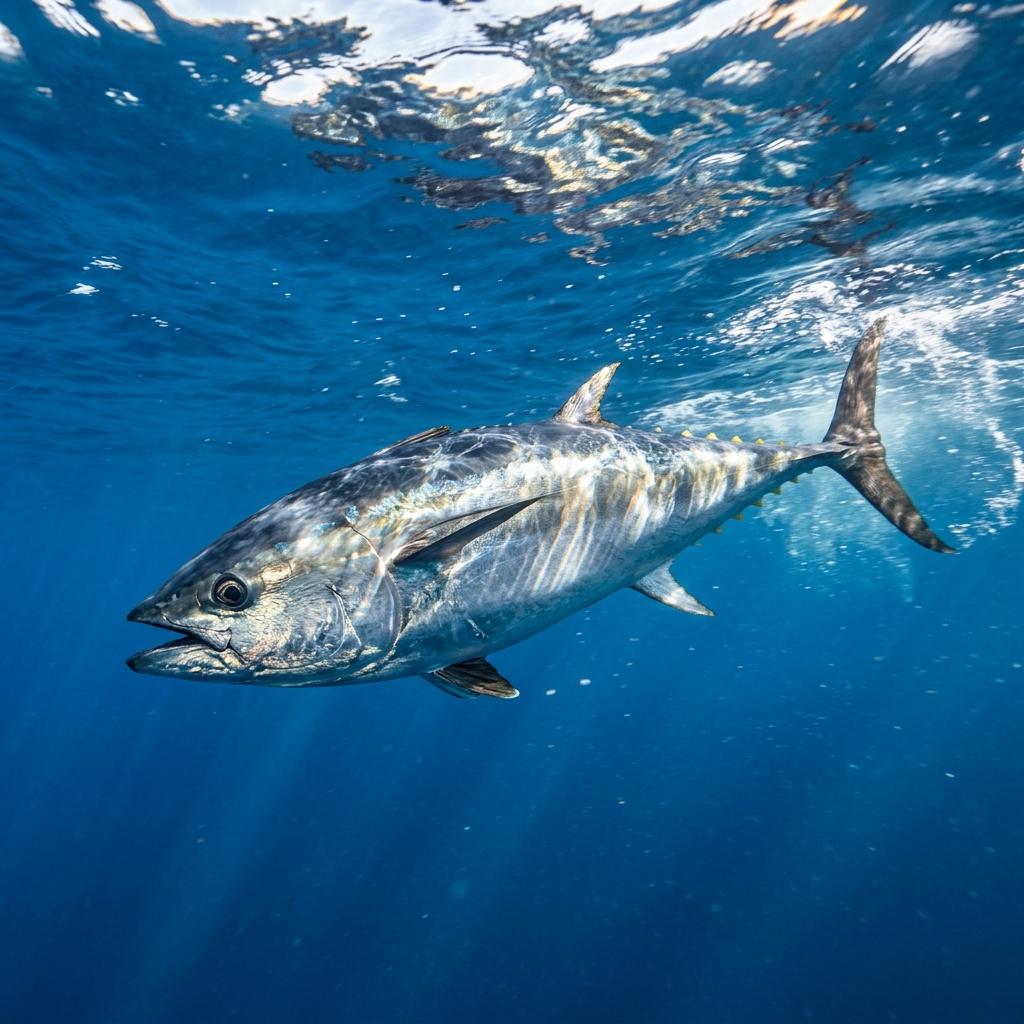
Its torpedo-shaped form reduces resistance, while its narrow tail base and crescent-shaped tail generate powerful forward thrust.
Several physical adaptations make this possible:
- Streamlined body: Minimizes water resistance during fast swimming.
- Crescent-shaped tail: Generates efficient propulsion over long distances.
- Retractable fins: Help reduce drag at higher speeds.
- Powerful muscles: Provide strength for both sustained swimming and bursts of acceleration.
- Small finlets: Help manage water flow toward the tail.
The result is a fish capable of combining impressive speed with outstanding endurance.
National Geographic
+1
2. The Secret of Its Warm Muscles
Most fish have body temperatures that closely follow the surrounding water. Bluefin tuna are different.
They possess specialized blood vessels that transfer heat from warm blood leaving their swimming muscles to cooler blood returning from the gills.
This process, known as countercurrent heat exchange, allows important body tissues to remain warmer than the surrounding ocean.
Warmer muscles provide major advantages, including more powerful swimming, efficient hunting in cold water, and the ability to explore different ocean environments.
However, bluefin tuna are not warm-blooded in exactly the same way as mammals; they maintain elevated temperatures in selected body regions.
NOAA Fisheries
+1
3. Masters of Long-Distance Migration
Bluefin tuna are extraordinary ocean travelers.
Atlantic bluefin tuna can migrate across the North Atlantic between feeding and spawning regions. Pacific bluefin tuna can cross the Pacific Ocean during their lives.
These journeys allow them to exploit productive feeding grounds while returning to suitable waters for reproduction.
Some tuna are tracked with electronic tags that record information about movement, water temperature, and diving behavior, helping scientists understand their ocean-spanning migrations.
Smithsonian Ocean
+1
4. An Efficient Ocean Predator
Bluefin tuna hunt a variety of marine animals, including sardines, anchovies, herring, mackerel, squid, and crustaceans.
Their speed makes them effective hunters of schooling fish. They can accelerate toward prey and maneuver through groups of smaller animals.
Their metallic blue backs and silvery undersides also provide natural camouflage, making them harder to detect against the dark ocean below or the brighter surface above.
Adult bluefin tuna are formidable predators, although large sharks and killer whales can still hunt them.
Ocean Conservancy
+1
5. Three Remarkable Bluefin Species

Atlantic Bluefin Tuna (Thunnus thynnus)
The largest bluefin species, found across the Atlantic Ocean and Mediterranean Sea. Famous for its enormous size, strength, and long-distance migrations.

Pacific Bluefin Tuna (Thunnus orientalis)
An impressive migratory predator that travels throughout the North Pacific, including journeys between waters near Japan and North America.

Southern Bluefin Tuna (Thunnus maccoyii)
Found primarily in the Southern Hemisphere, this species inhabits temperate ocean waters and remains an important focus of international conservation.
6. Conservation: Protecting an Ocean Giant
Bluefin tuna are highly valuable in commercial fisheries, especially in premium seafood markets. Historically, intensive fishing placed severe pressure on some populations.
Conservation programs now use catch limits, scientific stock assessments, monitoring, and international cooperation to support sustainable management.
There have been meaningful improvements. The IUCN reassessment in 2021 classified Atlantic bluefin tuna as Least Concern and Southern bluefin tuna as Endangered. A 2025 OSPAR assessment reported substantial recovery of Atlantic bluefin stocks within its assessment area.
Nevertheless, conservation success differs among populations, and continued monitoring is essential.
OSPAR
+1
7. Five Incredible Bluefin Tuna Facts
- Bluefin tuna can maintain their swimming muscles at temperatures above surrounding seawater.
- Their fins can fold into grooves to improve streamlining.
- Their tails provide powerful, efficient propulsion.
- They can undertake migrations spanning thousands of kilometres.
- Their biology combines speed, endurance, temperature regulation, and sophisticated ocean navigation.
Conclusion
The bluefin tuna is far more than a fast fish. It is a remarkable example of evolutionary engineering, combining hydrodynamic efficiency, powerful muscles, advanced heat conservation, and extraordinary endurance.
Protecting these ocean travelers is important not only for the species themselves but also for the health and balance of marine ecosystems.
SEO and Publishing Details
SEO title: Bluefin Tuna: Built for Speed | Ocean’s Powerful Predator
URL slug: bluefin-tuna-built-for-speed
Meta description: Discover how bluefin tuna achieve incredible speed, retain body heat, hunt ocean prey, migrate vast distances, and survive in the open sea.
Focus keyword: Bluefin Tuna
Secondary keywords: Atlantic Bluefin Tuna, Fastest Ocean Fish, Tuna Swimming Speed, Bluefin Tuna Facts, Marine Predators
Category: Fishes / Marine Life
Suggested featured image: Full-body bluefin tuna swimming through deep-blue ocean water, showing its torpedo-shaped body and powerful crescent tail.
Image alt text: Bluefin tuna swimming underwater, showing its streamlined body built for speed.
Suggested references: NOAA Fisheries · Smithsonian Ocean · IUCN Red List
Publication status: Article prepared for fishes.bin3aiah.net; not yet published. A complete media gallery and embedded videos would still need to be added to meet the site’s publishing requirements.