
Views: 1
Royal Gramma: The Colorful Fish of Caribbean Reefs
The Royal Gramma (Gramma loreto), also known as the Fairy Basslet, is one of the most beautiful small fish inhabiting the coral reefs of the Caribbean Sea. Famous for its remarkable purple-and-yellow coloration, this tropical species combines striking beauty with fascinating natural behavior.

Despite reaching only around 8 centimeters in length, the Royal Gramma has attracted considerable attention from marine biologists, divers, underwater photographers, and saltwater aquarium enthusiasts.
Royal Gramma: Quick Facts
| Scientific Name | Gramma loreto |
| Common Names | Royal Gramma, Fairy Basslet |
| Family | Grammatidae |
| Maximum Length | Approximately 8 cm |
| Natural Habitat | Coral reefs, caves, rocky overhangs |
| Distribution | Caribbean Sea and tropical western Atlantic |
| Diet | Zooplankton and small crustaceans |
| Temperament | Generally peaceful, territorial near shelters |
| Conservation Status | Least Concern (IUCN) |
1. A Spectacular Purple-and-Yellow Appearance
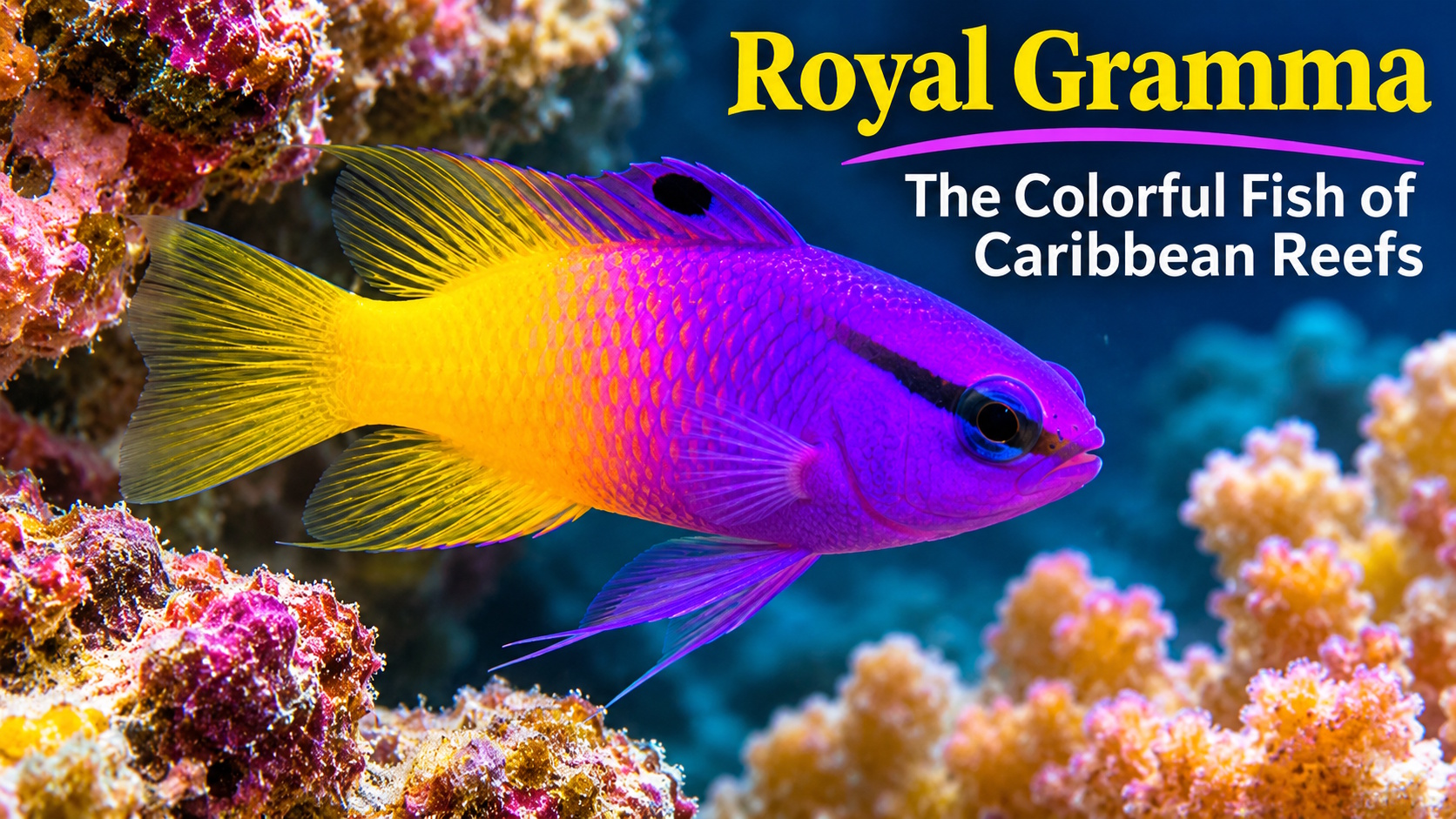
The Royal Gramma is instantly recognizable because its body displays two contrasting colors. The front half, including the head, is typically deep violet or purple, while the rear half transitions into brilliant golden yellow.
Its appearance includes several distinguishing features:
- A vibrant purple head and front body.
- A striking yellow rear body and tail.
- A dark stripe passing through the eye.
- A distinctive dark spot on the dorsal fin.
- Small, streamlined fins for maneuvering around reef structures.
Unlike some similarly colored fish, the Royal Gramma usually exhibits a relatively gradual transition between its purple and yellow regions.

2. Where Do Royal Grammas Live?
The Royal Gramma is native to the tropical western Atlantic, particularly the Caribbean region.
It occurs around reefs and rocky habitats near locations such as the Bahamas, Cuba, the Cayman Islands, and parts of Central America.
Its preferred environments include:
- Coral reefs with abundant hiding places.
- Rocky crevices and small caves.
- Shaded reef walls and overhangs.
- Sheltered areas with access to passing plankton.
Royal Grammas may be encountered in relatively shallow reef habitats as well as deeper waters. They frequently remain close to shelter, retreating into narrow openings when disturbed.
3. Behavior and Territorial Nature
Although the Royal Gramma is generally peaceful, it can become territorial around its favorite shelter.
Individuals often establish small home areas near rocks or caves and defend these spaces against competing fish, particularly members of their own species.
When threatened, a Royal Gramma usually retreats rapidly into a crevice rather than engaging in prolonged confrontation.
Its ability to navigate unusual surfaces and positions makes it especially fascinating to observe underwater.

4. What Does the Royal Gramma Eat?
Royal Grammas are small carnivorous fish that feed primarily on zooplankton and tiny crustaceans.
Their natural diet can include:
- Small planktonic crustaceans.
- Copepods and similar tiny marine animals.
- Other suitable drifting invertebrate prey.
They commonly position themselves near reef shelters where passing currents bring food particles and small organisms within reach.
Royal Grammas have also been observed participating in cleaning interactions by removing external parasites from other fish.
5. Reproduction and Nest Building
Royal Grammas exhibit interesting reproductive behavior involving protected nesting sites.
During breeding, males construct nests in sheltered reef cavities, often using small pieces of algae and other available materials.
Females deposit eggs within these protected locations, and males guard the developing eggs.
After hatching, larvae enter a planktonic stage before eventually settling into suitable reef habitats.
This reproductive strategy illustrates the importance of crevices and other structural features within healthy reef ecosystems.
6. Royal Gramma in Saltwater Aquariums
The Royal Gramma is popular among marine aquarium enthusiasts because of its relatively small size, spectacular coloration, and compatibility with many peaceful reef species.
However, successful long-term care requires a properly established saltwater aquarium.
Basic Aquarium Requirements
- Tank Size: Approximately 110 liters or larger is a practical starting point for one adult.
- Temperature: Approximately 24–27°C.
- Salinity: Around 1.023–1.026 specific gravity.
- Environment: Stable water chemistry and good filtration.
- Decoration: Live rock, caves, and hiding spaces.
- Food: Quality marine carnivore pellets, mysis shrimp, and suitable frozen foods.
Royal Grammas generally coexist well with compatible reef fish, but special care is necessary when keeping multiple individuals because territorial disputes may occur.
Captive-bred specimens are a responsible option when available and can help reduce pressure on wild populations.
7. Conservation and Threats
The Royal Gramma is listed as Least Concern on the IUCN Red List. Nevertheless, the Caribbean reef ecosystems on which it depends face significant environmental pressures.
These include:
- Coral bleaching and ocean warming.
- Declining reef habitat quality.
- Pollution and coastal development.
- Invasive predators such as lionfish.
- Unsustainable collection practices in some marine fisheries.
Protecting coral reefs and encouraging responsible marine aquarium practices can help safeguard this species and other reef-dependent organisms.
8. Why the Royal Gramma Is Special
Few small reef fishes combine such vivid colors with such unusual behavior.
The Royal Gramma is remarkable because of its beautiful purple-and-yellow body, its tendency to swim beneath overhangs, its specialized reef habitat, and its fascinating nesting behavior.
For underwater photographers, it provides a colorful subject. For marine enthusiasts, it offers an opportunity to appreciate the rich diversity of Caribbean coral reef life.
Conclusion
The Royal Gramma is a magnificent example of the beauty and complexity of tropical marine ecosystems. Although small, it possesses striking coloration, unusual swimming habits, and important adaptations for life among coral reefs.
From the clear waters of the Caribbean to carefully maintained marine aquariums, this remarkable fish continues to inspire fascination and appreciation for underwater biodiversity.
Protecting healthy reef habitats remains essential to preserving the colorful marine life that makes our oceans extraordinary.
Photography Credits
Images supplied through Wikimedia Commons. Original photographs have not been intentionally modified.
1. H. Zell — Original photograph — CC BY-SA 3.0.
2. Emőke Dénes — Original photograph — CC BY-SA 4.0.
3. Dan Schofield — Original photograph — CC BY 4.0.