
Views: 2
Giant Manta vs Reef Manta: Understanding the Differences
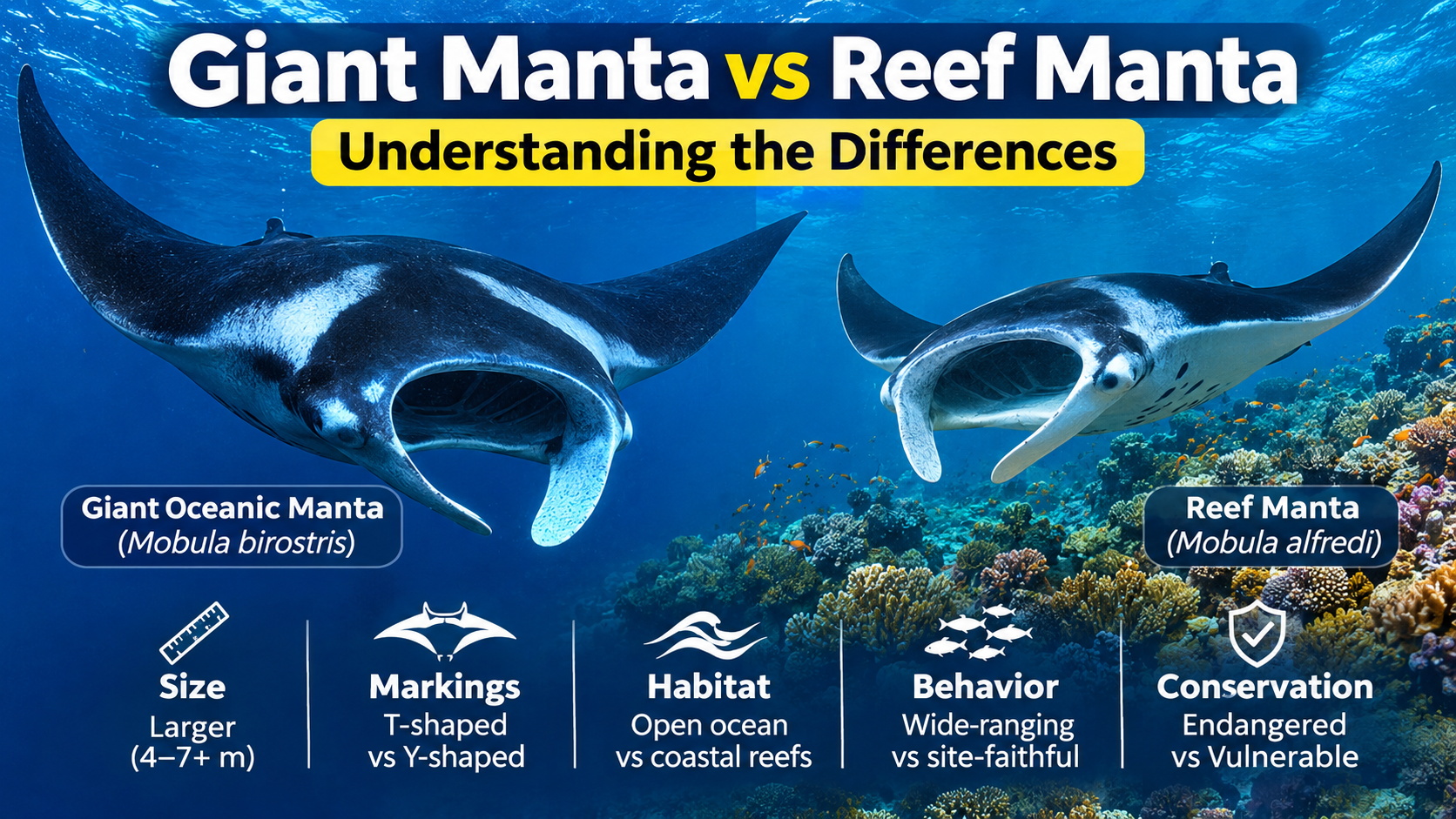
Giant oceanic manta rays and reef manta rays are among the most impressive animals in the sea. Both have enormous wing-like fins, graceful swimming movements, and specialized feeding systems that allow them to consume tiny plankton. Despite their similarities, these two species differ in size, appearance, habitat, behavior, and conservation needs.

Giant Manta vs Reef Manta: Quick Comparison
| Characteristic | Giant Oceanic Manta | Reef Manta |
|---|---|---|
| Scientific name | Mobula birostris | Mobula alfredi |
| Typical wingspan | 4–5 meters | 3–4 meters |
| Maximum wingspan | Over 7 meters | Over 5 meters |
| Primary habitat | Offshore and oceanic waters | Coastal reefs and island systems |
| Shoulder markings | More angular, often T-shaped | More curved, often Y-shaped |
| Belly patterns | Usually no spots between gill slits | Often spots between gill slits |
| Movement | Often wide-ranging | Frequently locally resident |
| IUCN status | Endangered | Vulnerable |
1. Size: Which Manta Ray Is Bigger?
The giant oceanic manta is the larger species. Some individuals can exceed seven meters across their pectoral fins, making them among the widest living rays.
Reef mantas are generally smaller, with adult wingspans commonly around three to four meters. Exceptionally large individuals can exceed five meters.
However, size alone is not a reliable identification method. A young giant manta can be smaller than a mature reef manta, making body markings especially important.
2. Physical Appearance and Identification
Although both species have flattened, diamond-shaped bodies, their color patterns provide important identification clues.
Giant oceanic mantas often have sharply defined white shoulder patches on their dark upper surfaces. Their underside markings tend to leave the central region between the gill slits relatively clear. They also possess a small residual spine structure near the tail.
Reef mantas generally display more rounded shoulder patterns. Dark spots are commonly found between their gill slits, and they lack the same residual tail-base spine.

Each manta also has a unique arrangement of markings on its belly. Scientists use these patterns like fingerprints to identify individuals, estimate population sizes, and monitor movements over time.
3. Habitat: Open Ocean vs Coral Reefs
Giant oceanic mantas frequently occur around offshore islands, seamounts, and deep-water environments. They may travel considerable distances in search of suitable feeding conditions.
Reef mantas are more closely associated with coral reefs, lagoons, coastal waters, and island groups. Some populations repeatedly visit the same feeding and cleaning stations for many years.
These habitat preferences are not absolute. Giant mantas sometimes enter coastal waters, while reef mantas can venture away from reefs. Habitat should therefore be considered alongside physical characteristics.
4. Feeding: How Do Manta Rays Eat?
Both giant and reef manta rays are filter feeders. Their diet primarily consists of small planktonic organisms, including tiny crustaceans.
They use two flexible head fins, called cephalic lobes, to guide plankton-rich water toward their mouths. Specialized filtering structures associated with the gills capture food particles as seawater passes through.
Manta rays may feed individually or gather where plankton concentrations are particularly high. When feeding conditions are favorable, groups can perform coordinated movements and circular swimming patterns to capture food efficiently.
5. Behavior and Movement Patterns
Reef manta rays often display strong site fidelity, meaning individual animals repeatedly return to familiar locations. This makes them relatively accessible to long-term researchers and underwater photographers.

Giant oceanic mantas often make longer-distance movements between productive feeding environments. Their movements can be influenced by seasonal changes, ocean currents, and the availability of plankton.
Both species may visit cleaning stations where small fish remove parasites and unwanted material from their bodies.
6. Intelligence and Social Interactions
Manta rays have notably large brains relative to their body size compared with many other fish. Research suggests they possess sophisticated sensory abilities, learning capabilities, and complex social behavior.
Reef mantas have been particularly useful for studying social networks because certain populations can be observed repeatedly at the same locations.
Interactions between manta rays may involve following behavior, group feeding, courtship, and repeated associations between individuals.
7. Reproduction and Life Cycle
Manta rays reproduce slowly compared with many other fish. Females usually give birth to one well-developed pup at a time following a lengthy pregnancy.
They do not produce enormous numbers of offspring, and reproductive intervals may extend over several years.
This slow reproductive strategy makes manta populations especially vulnerable to fishing pressure. When mature animals are removed from a population, recovery can take many years.
8. Conservation: Why Both Species Are Threatened

Both species face threats from commercial fishing, accidental capture, entanglement, marine pollution, and disturbance in important habitats.
In some fisheries, manta rays have been targeted for their gill-filtering plates. Their slow reproduction makes sustained fishing pressure particularly harmful.
According to IUCN assessments, the giant oceanic manta is classified as Endangered, while the reef manta is classified as Vulnerable.
Conservation measures include stronger fisheries regulations, protection of important feeding areas, responsible wildlife tourism, and international cooperation.
9. Are There More Than Two Manta Ray Species?
Yes. Scientists formally described a third manta ray species, the Atlantic manta ray (Mobula yarae), in 2025.
The currently recognized manta ray species are:
- Giant oceanic manta ray (Mobula birostris)
- Reef manta ray (Mobula alfredi)
- Atlantic manta ray (Mobula yarae)
This discovery demonstrates that even large, familiar marine animals can still hold important scientific surprises.
10. Which Manta Ray Are You Most Likely to See?
For recreational divers visiting tropical reef destinations, reef mantas are often more predictably encountered because many return regularly to established feeding and cleaning locations.
Giant oceanic mantas may be encountered near offshore islands and seamounts, particularly where ocean conditions concentrate plankton.
Responsible encounters should always allow manta rays to control their movements. Divers and snorkelers should avoid touching, chasing, blocking, or crowding these animals.
Conclusion
The giant oceanic manta and reef manta are closely related but distinct marine species. The giant manta is usually larger and more wide-ranging, while the reef manta is more closely associated with coastal reef systems and familiar feeding grounds.
Their differences in size, markings, habitat, and movement are important for accurate identification and effective marine research.
Protecting both species helps preserve not only these extraordinary ocean animals but also the marine ecosystems on which they depend.
Scientific Sources and Further Reading
- Marine Megafauna Foundation — Manta Ray Identification
- Manta Trust — Manta and Devil Ray Species
- NOAA Fisheries — Giant Manta Ray
- Georgia Aquarium — Third Manta Ray Species Discovery
Images courtesy of Wikimedia Commons contributors. Attribution and applicable Creative Commons license links are provided in the image captions. No image modifications are indicated.