
Views: 0
Atlantic Blue Marlin: Built for Life in the Open Ocean

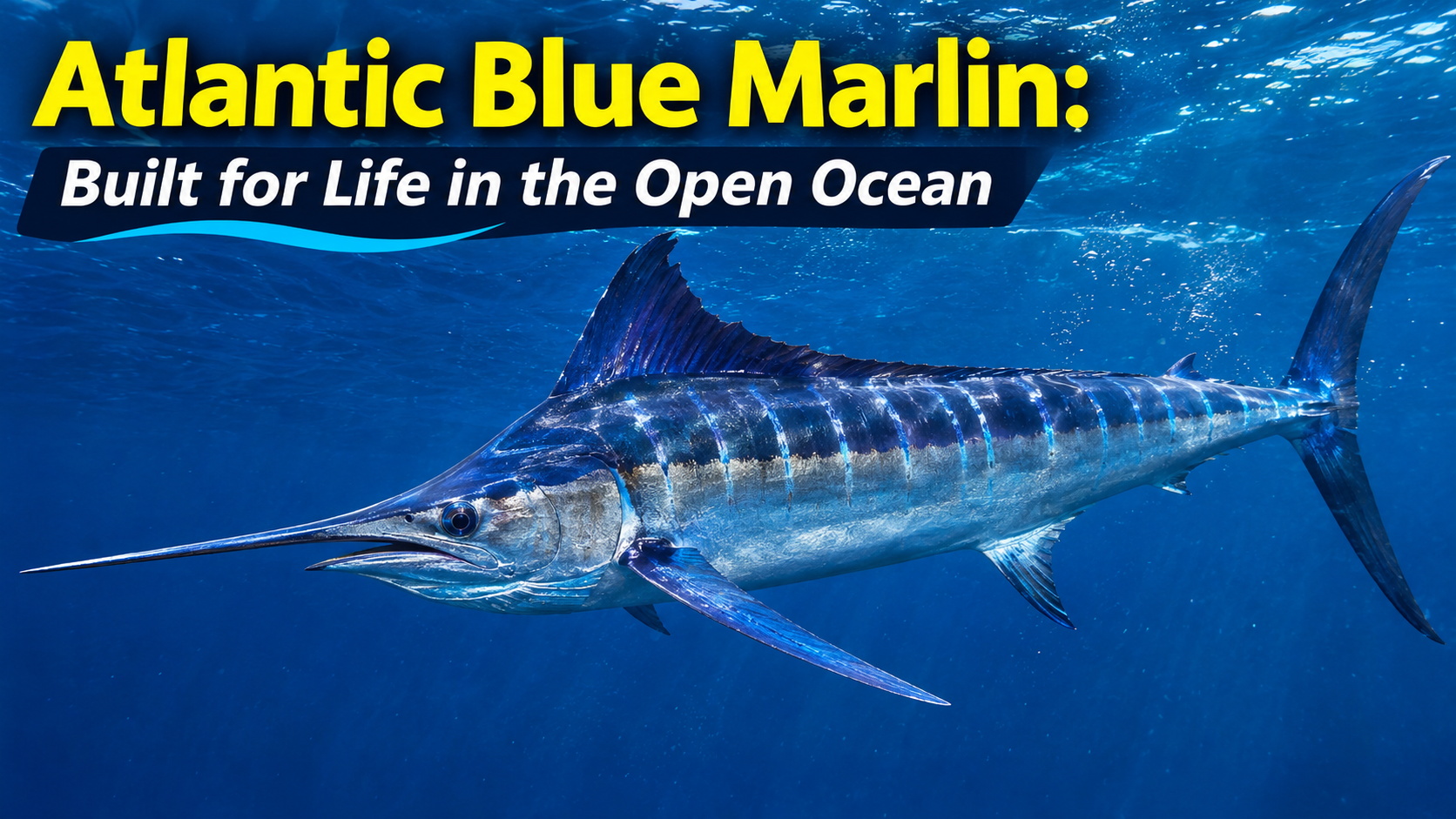
The Atlantic blue marlin (Makaira nigricans) is one of the most extraordinary predators in the Atlantic Ocean. With its elongated bill, streamlined body, powerful tail, and striking blue coloration, this large billfish is perfectly adapted to life in the open sea.
Unlike many fish that depend on coral reefs or coastal habitats, the Atlantic blue marlin spends much of its life in deep offshore waters. It travels enormous distances in search of food, moving through an environment where speed, endurance, and hunting efficiency are essential for survival.
Atlantic Blue Marlin: Quick Facts
- Scientific name: Makaira nigricans
- Family: Istiophoridae
- Habitat: Tropical and warm-temperate Atlantic Ocean
- Maximum length: More than 4 metres in exceptional specimens
- Diet: Fish and squid
- Behavior: Primarily solitary and highly migratory
- Reproduction: Egg-laying with external fertilization
- Conservation status: Vulnerable (IUCN)
1. A Body Designed for Powerful Swimming
The Atlantic blue marlin has a remarkable combination of physical adaptations that allow it to move efficiently through the ocean.
Its elongated body reduces water resistance, while its muscular tail and crescent-shaped tail fin generate powerful propulsion. Its dorsal and pectoral fins help maintain balance and control during swimming.
The marlin’s upper body is dark blue, while its underside is silvery white. Pale vertical stripes may be visible along its sides. This coloration provides a degree of camouflage in open water.
Although marlin are widely described as extremely fast swimmers, exact maximum-speed claims are difficult to verify under natural conditions.
2. The Long Bill: An Effective Hunting Tool

One of the blue marlin’s most recognizable features is its long, pointed upper jaw, commonly known as a bill.
This structure is not simply decorative. The fish can use its bill to strike prey, sometimes sweeping it sideways through groups of smaller fish.
Such strikes can injure or disorient prey, making them easier to capture and swallow.
Its diet includes several types of fast-swimming fish and cephalopods, including:
- Tuna
- Mackerel
- Dolphinfish
- Other pelagic fish
- Squid
The combination of powerful swimming and specialized hunting behavior makes blue marlin formidable ocean predators.
3. Life in the Vast Atlantic Ocean
The Atlantic blue marlin inhabits tropical and warm-temperate parts of the Atlantic Ocean. It is a pelagic species, meaning that it spends its life in the open-water environment rather than remaining close to the seabed.
Marlin are highly migratory animals. Their movements are influenced by ocean temperature, food availability, currents, and seasonal environmental changes.
They commonly use the warmer upper layers of the ocean but can make dives into deeper, cooler waters.
For these fish, migration is an essential survival strategy. Moving across large ocean areas allows them to follow productive feeding grounds and reach suitable reproductive environments.
4. Adaptations for Finding Prey
Life in the open ocean presents a major challenge: food is not distributed evenly.
A blue marlin may travel through large stretches of water before encountering an abundant food source.
Its keen vision helps detect potential prey, while its streamlined body supports efficient long-distance swimming.
Like other billfish, marlin possess specialized physiological adaptations that support eye and brain function across changing water temperatures.
These adaptations are especially valuable when moving between warmer surface waters and cooler depths.
5. Females Grow Much Larger Than Males
One particularly interesting feature of Atlantic blue marlin biology is the difference in adult size between males and females.
Females can grow substantially larger and heavier than males. Some exceptional females reach several hundred kilograms.
This difference, known as sexual size dimorphism, is an important characteristic of the species.
Larger females can produce very large numbers of eggs during reproductive activity.
6. Reproduction and Early Development
Atlantic blue marlin reproduce by spawning. Females release eggs into the water, where fertilization occurs externally.
The developing larvae are tiny and vulnerable to predators.
Young marlin initially look quite different from adults. Their characteristic elongated bills develop as they grow.
Although females can release enormous numbers of eggs, only a small proportion of offspring survive the challenges of early life.
Warm oceanic areas, including parts of the Caribbean and western Atlantic, provide important spawning habitats.
7. An Important Predator in the Marine Food Web
Atlantic blue marlin occupy an influential position in the open-ocean food web.
By consuming fish and squid, they help shape predator-prey relationships within pelagic ecosystems.
Young marlin are vulnerable to larger marine predators, while even adults may occasionally face threats from large sharks.
These interactions demonstrate that even powerful predators remain part of a complex and interconnected marine ecosystem.
8. Conservation and Fishing Pressure

Despite its impressive size and physical capabilities, the Atlantic blue marlin faces significant conservation challenges.
Commercial fishing operations can unintentionally catch marlin as bycatch, particularly in fisheries targeting tuna and other large pelagic fish.
Recreational fishing also requires careful management to protect vulnerable populations.
The species is classified as Vulnerable on the IUCN Red List.
According to the 2024 assessment by the International Commission for the Conservation of Atlantic Tunas (ICCAT), the Atlantic blue marlin stock remains overfished, although the assessment indicated that overfishing was not currently occurring.
Conservation efforts include international catch management, improved fishing practices, research, and monitoring of migratory populations.
9. Why the Atlantic Blue Marlin Is So Remarkable
Few marine predators combine so many extraordinary features in a single animal.
- A streamlined body adapted for rapid swimming
- A specialized bill used during hunting
- Long-distance migrations across the Atlantic
- Powerful muscles and a crescent-shaped tail
- Adaptations for hunting across different ocean depths
- A major size difference between males and females
Together, these characteristics make the Atlantic blue marlin one of the ocean’s most fascinating examples of evolutionary adaptation.
Conclusion
The Atlantic blue marlin is truly built for life in the open ocean. Its body, hunting strategies, movement patterns, and physiology allow it to survive in an immense and constantly changing marine environment.
Yet even such a powerful predator depends on healthy ocean ecosystems. Protecting blue marlin populations through responsible fisheries management and international conservation cooperation is essential for the future of this remarkable species.