
Views: 8
Anglerfish: Hunting in the Deep Ocean
Dunia Hewan: Mengapa Ikan Laut Dalam Terlihat Seperti Alien? – Semua Halaman – National Geographic
En lysande lösning | Forskning & Framsteg
6
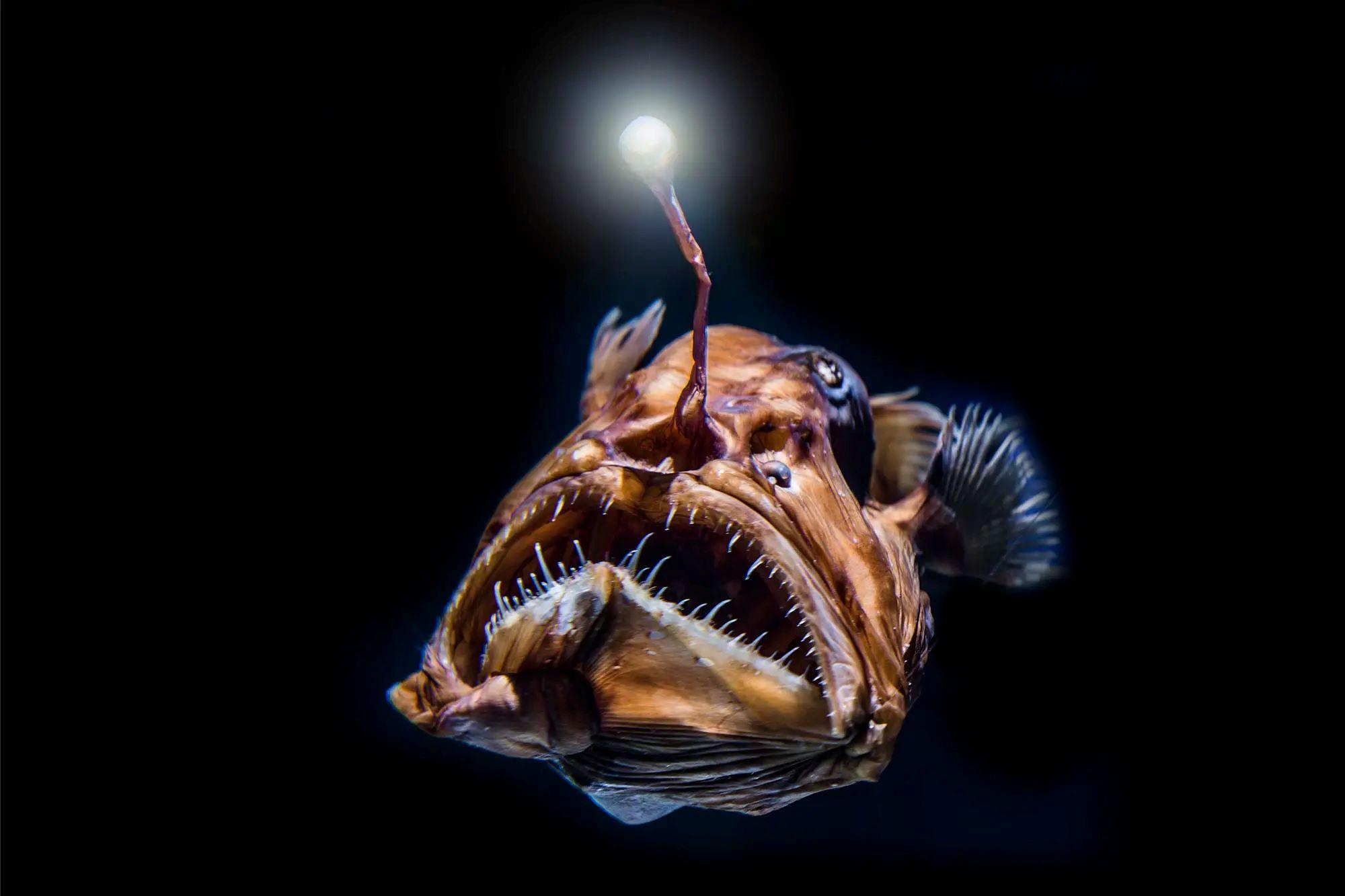
Deep beneath the ocean’s surface, where sunlight disappears and food is scarce, the anglerfish survives using one of nature’s most extraordinary hunting strategies: a glowing lure that attracts unsuspecting prey directly toward its mouth.
With its enormous jaws, needle-like teeth, and unusual appearance, the deep-sea anglerfish is a remarkable example of evolution in extreme environments.
1. Life in the Deep Ocean
Deep-sea anglerfish inhabit dark ocean waters, with different species living at different depths, often hundreds or thousands of meters below the surface.
Their environment presents several challenges:
- Permanent darkness: Sunlight cannot reach their deepest habitats.
- Extreme pressure: Water pressure increases dramatically with depth.
- Limited food: Prey can be difficult to locate.
- Cold temperatures: Deep-ocean waters are typically very cold.
Rather than continuously chasing prey, many anglerfish conserve energy by waiting for food to approach.
2. How the Glowing Lure Works
The anglerfish’s most famous adaptation is its biological fishing rod.
The rod, called the illicium, is a modified dorsal-fin spine. At its tip is a specialized structure called the esca, which produces or houses the source of light.
In many deep-sea species, symbiotic bioluminescent bacteria generate this glow. The bacteria receive nutrients and shelter, while the anglerfish gains an effective hunting tool.
The fish can position its lure near its mouth, attracting curious animals into striking distance. Smithsonian Ocean+1
3. The Perfect Ambush Predator
An anglerfish’s hunting strategy relies on patience and surprise.
Dunia Hewan: Mengapa Ikan Laut Dalam Terlihat Seperti Alien? – Semua Halaman – National Geographic
Stage 1 — Attraction
The glowing lure draws attention in the darkness.
“El diablo negro” fue visto en la superficie del océano, en España
Stage 2 — Ambush
When prey approaches, the predator rapidly opens its large mouth.
Stage 3 — Capture
Inward-pointing teeth help prevent captured animals from escaping.
Some species also have flexible jaws and expandable stomachs, allowing them to consume surprisingly large meals relative to their body size. Woods Hole Oceanographic Institution+1
4. The Extraordinary Difference Between Males and Females
One of the strangest characteristics of deep-sea anglerfish is their reproductive biology.
Females are often much larger than males. In certain species, a male attaches permanently to a female, eventually fusing with her body and receiving nutrients through their connected circulatory systems.
This unusual adaptation helps ensure reproduction in a vast environment where encounters between potential mates may be rare.
Importantly, not all anglerfish species reproduce through permanent attachment. Woods Hole Oceanographic Institution+1
5. Fascinating Anglerfish Facts
| Feature | Description |
|---|---|
| Scientific group | Order Lophiiformes |
| Habitat | Deep and shallow marine environments, depending on species |
| Hunting method | Luring and ambush |
| Diet | Fish and other marine animals |
| Light production | Often through symbiotic bacteria in deep-sea species |
| Teeth | Long, sharp, frequently inward-pointing |
| Reproduction | Some species exhibit permanent male attachment |
6. Why Anglerfish Matter
Anglerfish are important predators in marine food webs and demonstrate how life adapts to environments with extremely limited resources.
Scientists study them to understand bioluminescence, deep-sea ecology, evolutionary adaptation, and unusual reproductive biology.
The anglerfish reminds us that even the darkest parts of our planet contain complex and extraordinary life.
SEO settings for WordPress
SEO title
Anglerfish: Hunting in the Deep OceanSlug
anglerfish-hunting-in-the-deep-oceanMeta description
Explore how deep-sea anglerfish hunt with glowing lures, sharp teeth, and remarkable adaptations that help them survive in the dark ocean.
CopyCategory
Marine Life / Deep-Sea FishTags
Anglerfish, Deep Sea, Deep Ocean, Marine Biology, Bioluminescence, Ocean Predators, Deep-Sea Creatures, Fish Adaptations, Underwater Wildlife, Marine Life
Copy tags
Suggested featured image: A female deep-sea anglerfish surrounded by dark ocean water, with a glowing blue lure suspended just above its sharp teeth.
Image alt text: Deep-sea anglerfish using a bioluminescent lure to attract prey in the dark ocean.
Scientific references: Smithsonian Ocean and NOAA Ocean Exploration.