
Views: 7
Pufferfish: Defensive Adaptations and Biology
Marine Life • Fish Biology • Ocean Wildlife • 8-minute read


9
The pufferfish is one of the ocean’s most extraordinary survivors. Famous for its remarkable ability to inflate its body into a balloon-like shape, this unusual fish possesses a combination of physical defenses, chemical protection, specialized feeding structures, and fascinating behavior.
Pufferfish belong to the family Tetraodontidae, a diverse group of fish found in marine, brackish, and freshwater environments. Their distinctive biology provides an excellent example of how evolution has produced specialized adaptations for surviving in environments filled with predators.
1. What Is a Pufferfish?
Pufferfish are members of the order Tetraodontiformes, which also includes triggerfish, boxfish, porcupinefish, and ocean sunfish.
Their most recognizable characteristics include rounded bodies, large eyes, small fins, powerful jaws, and the ability to inflate when threatened.
| Characteristic | Description |
|---|---|
| Scientific family | Tetraodontidae |
| Known species | Approximately 200 |
| Habitat | Oceans, estuaries, and freshwater |
| Distribution | Tropical and temperate regions |
| Diet | Mollusks, crustaceans, algae, and other organisms |
| Main defenses | Inflation, toxins, camouflage, and prickles |
| Reproduction | Egg-laying |
Pufferfish are often confused with porcupinefish, but porcupinefish belong to a separate family, Diodontidae, and typically possess longer, more prominent spines.
Smithsonian Ocean
+1
2. How Do Pufferfish Inflate?

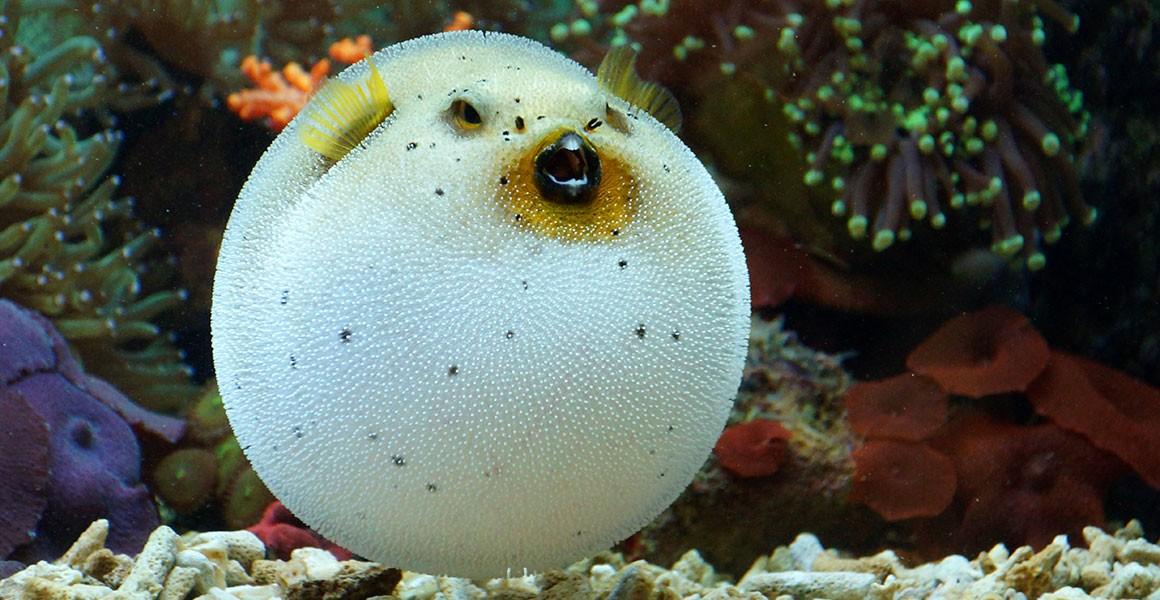
The ability to inflate is the pufferfish’s most famous defensive adaptation.
When a predator approaches, a pufferfish can rapidly increase its body volume, transforming from a relatively compact fish into a rounded, difficult-to-swallow object.
The inflation process
- Detecting danger: The fish senses a potential predator through vision and other sensory systems.
- Taking in water: It rapidly pumps water through its mouth into its expandable stomach.
- Expanding its body: Specialized elastic tissues allow the stomach and skin to stretch.
- Increasing protection: The inflated body becomes harder for a predator to capture or swallow.
- Returning to normal: Once the threat passes, the fish expels the water and gradually returns to its original shape.
Research has shown that pufferfish can remain inflated while continuing to obtain oxygen through their gills. Inflation is nevertheless physically demanding and should not be deliberately triggered by divers or aquarium keepers.
PMC
+1
3. Tetrodotoxin: A Powerful Chemical Defense
One of the most remarkable features of many pufferfish species is their association with a potent neurotoxin called tetrodotoxin (TTX).
Tetrodotoxin interferes with voltage-gated sodium channels in nerve and muscle cells, disrupting the transmission of electrical signals.
Severe poisoning can cause numbness, weakness, paralysis, respiratory failure, and potentially death.
Important facts about pufferfish toxins
- Toxicity varies considerably between species and individuals.
- Certain tissues, including the liver and reproductive organs, may contain particularly high toxin concentrations.
- Diet and toxin-producing microorganisms can contribute to tetrodotoxin accumulation.
- Not every pufferfish is toxic to the same degree.
- Cooking does not reliably eliminate tetrodotoxin.
In Japan, some pufferfish are prepared as fugu under strict professional handling requirements. Wild-caught pufferfish should never be treated as safe to prepare or eat without qualified species identification and appropriate food-safety controls.
Chemical defense complements inflation by making many pufferfish potentially dangerous prey.
Smithsonian Ocean
+1
4. Specialized Teeth and Feeding Biology

Unlike fish with numerous separate teeth, pufferfish possess dental structures fused into a powerful beak-like arrangement.
The family name Tetraodontidae refers to their characteristic four-part dental structure.
These strong jaws allow many pufferfish to crush hard-shelled prey, including snails, mollusks, and crustaceans.
Different species have different feeding preferences. Some consume algae and sponges, while others specialize in bottom-dwelling invertebrates.
Their feeding activity can influence the abundance and distribution of smaller organisms in reef and coastal ecosystems.
FAOHome
+1
5. Habitat and Distribution
Pufferfish inhabit a surprisingly broad range of aquatic environments.
Coral reefs
Many marine species shelter among rocks and coral formations, feeding on a variety of reef organisms.

Coastal and brackish waters
Estuaries, mangroves, and coastal lagoons provide food and shelter for species adapted to changing salinity.

Freshwater habitats
Freshwater pufferfish inhabit rivers, lakes, and streams, including small species such as the pea puffer.
Their diverse habitats illustrate the evolutionary flexibility of the pufferfish family.
NOAA Institutional Repository
+1
6. Movement, Vision, and Behavior
Pufferfish generally swim using coordinated movements of their small fins, allowing them to maneuver carefully around reefs and underwater obstacles.
Although they are not usually fast long-distance swimmers, they possess impressive control during slow movement.
Their prominent eyes provide useful awareness of the surrounding environment. Some species can move their eyes independently and adjust body coloration.
Behavior varies by species, ranging from solitary territorial lifestyles to complex reproductive displays.
7. Reproduction and Unusual Courtship
Pufferfish reproduce by laying eggs, but reproductive strategies vary.
One especially remarkable example is the male white-spotted pufferfish (Torquigener albomaculosus), known for constructing elaborate circular patterns in sand on the seafloor.
These geometric structures are created through repeated swimming and fin movements and form part of the species’ courtship behavior.
Some pufferfish also exhibit nest guarding or other forms of parental behavior, demonstrating that their biology extends far beyond defensive inflation.
8. Predators and Survival Strategies
Despite their defenses, pufferfish are not completely protected from predation.
Larger fish and other marine predators may attack them, and some predators can overcome their protective adaptations.
Their survival strategies combine several mechanisms:
- Rapid inflation to increase apparent size.
- Prickles or spines in certain species.
- Chemical defenses in toxic species.
- Camouflage and protective coloration.
- Shelter-seeking and cautious movement.
These overlapping defenses reduce vulnerability, though their effectiveness depends on the species and predator involved.
9. Conservation and Environmental Threats
Although many pufferfish populations remain widespread, particular species face environmental pressures.
Coastal development, habitat degradation, pollution, and changes to marine ecosystems can affect their food sources and breeding areas. Some species may also be affected by fishing pressure or collection for the aquarium trade.
Other pufferfish have expanded into regions where they are non-native, creating ecological problems of their own.
Effective conservation therefore requires a species-specific approach rather than assuming all pufferfish face identical threats.
Research Online
+1
10. Fascinating Pufferfish Facts
Pufferfish can inflate to several times their ordinary body volume.
They use an expandable stomach rather than a special balloon organ.
Many species have powerful beak-like teeth for crushing food.
Some species are freshwater specialists.
Certain males create intricate sand circles during courtship.
Porcupinefish are relatives, not members of the same family.
Conclusion
Pufferfish demonstrate how remarkably specialized aquatic animals can become through evolution.
From expanding their bodies during danger to using powerful jaws, chemical defenses, and intricate reproductive behaviors, these fish represent an extraordinary combination of biological adaptations.
Studying pufferfish helps scientists understand predator-prey relationships, evolutionary development, physiology, and the diversity of life beneath the water’s surface.
Their fascinating biology is also a reminder of why protecting healthy aquatic ecosystems matters.
WordPress SEO — Ready to Copy
| Field | Content |
|---|---|
| SEO title | Pufferfish: Defensive Adaptations, Toxicity & Biology |
| Focus keyphrase | Pufferfish defensive adaptations |
| SEO slug | pufferfish-defensive-adaptations-biology |
| Category | Fishes / Marine Life |
| Meta description | Discover how pufferfish inflate, use tetrodotoxin for defense, crush prey with powerful jaws, and survive in marine and freshwater habitats. |
WordPress tags:
Pufferfish, Puffer Fish, Tetraodontidae, Marine Biology, Marine Life, Ocean Animals, Fish Species, Defensive Adaptations, Tetrodotoxin, Toxic Fish, Coral Reef Fish, Freshwater Fish, Fish Anatomy, Marine Ecosystems, Underwater Wildlife, Ocean Conservation
Copy tags
Recommended Featured Image
Featured image alt text: Pufferfish swimming near a coral reef, displaying its distinctive rounded body and defensive adaptations.
References
- Smithsonian Ocean — Pufferfishes and Their Relatives
- Natural History Museum — Pufferfish Biology
- Scientific Research — Pufferfish Inflation and Respiration
For publication on fishes.bin3aiah.net, the article is ready as editorial content. The next useful step is to convert it into a single mobile-friendly WordPress HTML block with embedded images, image credits, and video links.