
Views: 16
Sailfish: The Remarkable Ocean Hunter


10
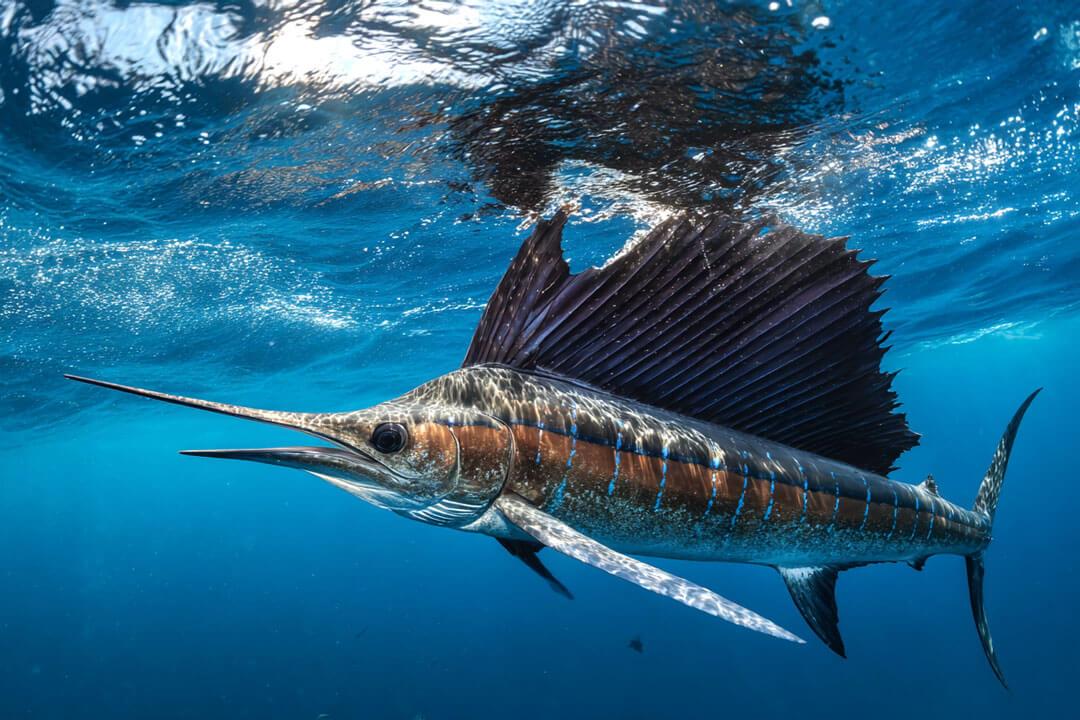
The sailfish is one of the ocean’s most extraordinary predators. Famous for its spectacular sail-shaped dorsal fin, elongated bill, and remarkable bursts of speed, this powerful fish is perfectly adapted for hunting in the open sea.
Belonging to the billfish family Istiophoridae, sailfish combine agility, coordinated hunting behavior, and specialized anatomy to capture fast-moving prey.
1. What makes the sailfish special?
Scientific name
Istiophorus platypterus
Maximum length
3.4 m
Maximum weight
100 kg
Habitat
Warm oceans
Sailfish are instantly recognizable through their distinctive physical features:
- Giant dorsal fin: Their sail can be raised or folded into a groove along the back.
- Long, pointed bill: Used to strike, slash, and destabilize prey.
- Streamlined body: Reduces resistance while swimming.
- Changing coloration: Their skin can display vivid blue and dark vertical stripes during hunting or excitement.
2. How fast can a sailfish swim?

Sailfish are among the fastest marine predators, capable of explosive acceleration during attacks.
They have historically been credited with speeds exceeding 100 km/h, but those figures are not reliably supported by modern measurements. Research suggests that their actual hunting speeds are considerably lower, while still being impressive.
Their success depends on more than speed alone: maneuverability, timing, and precise bill strikes are essential.
3. A sophisticated hunting strategy


10
Sailfish frequently target sardines, anchovies, and other schooling fish.
Their hunting sequence typically involves:
- Approaching a school: Sailfish locate dense groups of prey.
- Separating individuals: They use positioning and rapid movements to isolate fish.
- Striking with the bill: Side-to-side slashes can injure or disorient prey.
- Capturing prey: The sailfish quickly swallows vulnerable fish.
When multiple sailfish hunt the same school, they may take turns attacking, increasing opportunities for successful captures.
4. Why is the sail-shaped fin important?
The enormous dorsal fin is not simply decorative. It may contribute to stability, maneuverability, and visual signaling during hunting.
Sailfish commonly keep the fin folded while swimming efficiently and raise it during certain maneuvers or interactions.
Its dramatic appearance also makes sailfish one of the most visually recognizable species in the open ocean.
5. Habitat and distribution
Sailfish inhabit tropical and subtropical waters across the Atlantic, Indian, and Pacific Oceans.
They are primarily pelagic animals, meaning they spend much of their lives in open water rather than near the seafloor. They often occupy warmer surface waters but can dive deeper while searching for prey.
6. Reproduction and life cycle
Female sailfish release large numbers of eggs into the water, where fertilization occurs externally.
Young sailfish grow rapidly, developing the elongated bill and distinctive dorsal fin that characterize adults. Their early life stages are vulnerable to numerous ocean predators.
7. Conservation and threats
Although sailfish are powerful hunters, they face pressures from human activities, particularly commercial fishing.
Major concerns include accidental capture in tuna and swordfish fisheries, targeted recreational fishing, and changes in marine ecosystems.
The IUCN has assessed the sailfish as Vulnerable globally, highlighting the importance of monitoring fishing pressure and protecting healthy ocean populations.
8. Fascinating sailfish facts
- Sailfish belong to the same family as marlins and spearfish.
- Their bills can strike prey without requiring the entire body to accelerate to the same speed.
- They can rapidly change the intensity of their visible body stripes.
- Their large dorsal fin can fold down to reduce drag.
- Sailfish are highly prized subjects for underwater wildlife photography.
Conclusion
The sailfish demonstrates how evolution has produced an exceptionally specialized ocean predator. Its speed, precision, dramatic appearance, and sophisticated hunting techniques make it one of the most fascinating fish in the marine world.
Protecting sailfish populations also helps preserve the balance and biodiversity of the open ocean.
SEO title: Sailfish: Speed, Hunting Techniques, Habitat and Amazing FactsMeta description: Discover the sailfish, one of the ocean’s most remarkable predators. Explore its speed, unique dorsal fin, hunting strategies, habitat, and conservation.Suggested URL slug: sailfish-remarkable-ocean-hunterKeywords: Sailfish, Istiophorus platypterus, sailfish speed, sailfish hunting, fastest ocean fish, marine predators, sailfish facts.