


Views: 0
Clown Triggerfish: Colors, Teeth and Reef Behavior
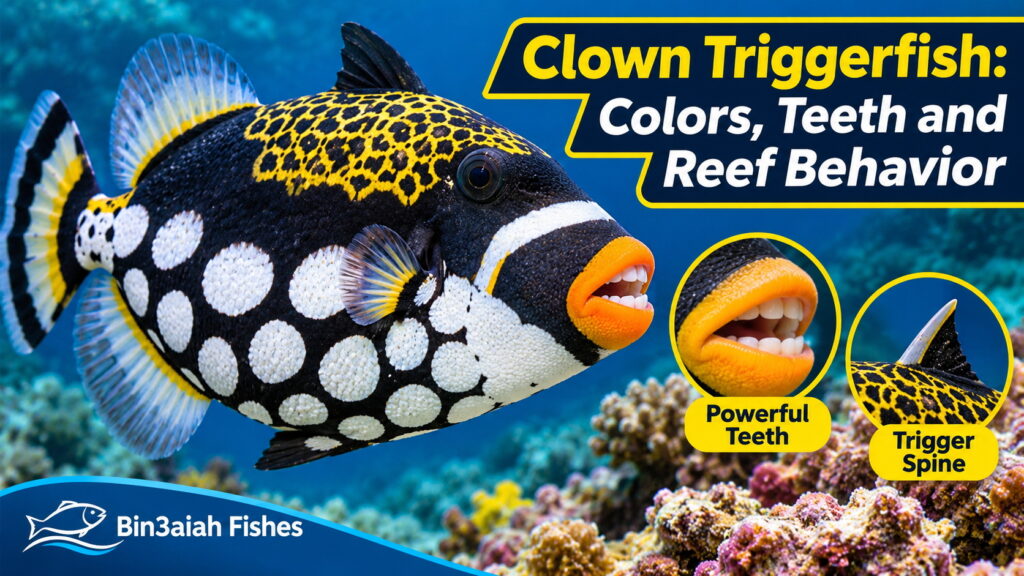
The clown triggerfish (Balistoides conspicillum) is one of the most spectacular fish found in tropical coral reefs. With its black body, oversized white spots, yellow patterns and orange-yellow lips, this species looks like a living underwater painting. But its unusual appearance is only part of the story. Behind those beautiful colors are powerful jaws, specialized teeth and an ingenious defensive mechanism.


Clown Triggerfish: Quick Facts
- Scientific name: Balistoides conspicillum
- Family: Balistidae
- Maximum length: Approximately 50 cm
- Habitat: Tropical coral reefs, outer reef slopes and drop-offs
- Distribution: Indo-Pacific, from East Africa to parts of the western and central Pacific
- Depth: Approximately 1–75 meters
- Diet: Sea urchins, crabs, crustaceans, mollusks and tunicates
- Behavior: Generally solitary, with defensive behavior when threatened
1. Extraordinary Colors and Patterns
The clown triggerfish has a distinctive pattern that sets it apart from almost every other reef fish. Large white spots decorate its dark lower body, while the upper back features an intricate yellow pattern with black markings. A pale stripe crosses the snout, and the lips are brilliantly colored in orange and yellow.
Its contrasting patterns make identification relatively easy. However, the coloration of younger fish can differ from that of adults, and individual markings may vary.


2. Powerful Teeth and Strong Jaws
Despite its colorful and almost playful appearance, the clown triggerfish is an effective predator of hard-bodied marine invertebrates.
Its jaws and strong teeth allow it to bite, manipulate and crush prey that would be difficult for many other reef fish to consume. Its natural diet includes sea urchins, crabs, other crustaceans, mollusks and tunicates.
The fish searches around rocks, coral structures and reef surfaces for food. These feeding adaptations help it exploit a range of prey living on or near the seabed.
3. The Remarkable Trigger Spine
One of the most interesting features of triggerfish is the special mechanism in their dorsal fin. The first large dorsal spine can be raised and locked into position by the second spine.
When frightened, a triggerfish may retreat into a narrow reef crevice and raise its dorsal spine, helping secure itself against removal by predators.
This defensive adaptation gives the triggerfish family its common name and is particularly useful in the complex environment of coral reefs.
4. Life and Behavior on Coral Reefs
Clown triggerfish usually live alone rather than forming large schools. Adults are frequently encountered around clear outer reefs, especially near steep drop-offs.
They swim around reef structures while searching for food and shelter. Younger individuals are typically more secretive and often remain close to caves and crevices.
Like other triggerfish, they can become defensive if threatened or cornered. Divers should observe these animals respectfully without touching or pursuing them.


5. Reproduction and Territorial Behavior
Triggerfish lay eggs on the seabed, and many members of the family protect their nesting areas. Such parental care can include guarding the eggs against potential predators.
Although the clown triggerfish is generally solitary, individuals may interact with others during reproductive activity. Their behavior can change depending on their surroundings and breeding condition.
6. Importance in the Coral Reef Ecosystem
The clown triggerfish contributes to reef food webs by consuming a variety of bottom-dwelling invertebrates. Predatory fish like this are part of the biological interactions that help shape coral reef communities.
Healthy reef habitats provide feeding grounds, hiding places and suitable environments for juvenile fish. Damage to coral reefs can reduce the availability of these important resources.
7. Can Clown Triggerfish Live in Aquariums?
The clown triggerfish is admired by aquarium enthusiasts for its striking appearance. However, it grows large, has powerful teeth and may behave aggressively toward tankmates.
Its long-term care requires a suitably large marine aquarium, strong filtration, secure rockwork, an appropriate diet and careful consideration of compatibility with other animals. It is not generally a suitable choice for beginners or small community aquariums.
8. Fascinating Clown Triggerfish Facts
- Its scientific name is Balistoides conspicillum.
- It belongs to the same family as other triggerfish species.
- It can grow to approximately 50 centimeters long.
- Its jaws are adapted to feed on hard-bodied marine animals.
- Its first dorsal spine forms part of a unique locking defense system.
- It is normally observed alone rather than in large schools.
- Juveniles commonly shelter in caves and small reef openings.
- It occurs across a wide Indo-Pacific distribution.
Conclusion
The clown triggerfish combines extraordinary coloration with impressive survival adaptations. Its bold white spots, vivid yellow patterns, powerful teeth and locking dorsal spine make it one of the most fascinating inhabitants of tropical coral reefs.
More than simply a beautiful fish, it is an active reef predator whose behavior and anatomy reveal the remarkable diversity of marine life. Protecting coral reef habitats helps preserve species like the clown triggerfish and the ecosystems they depend on.