


Views: 0
Giant Trevally: The Powerful Predator of Tropical Seas
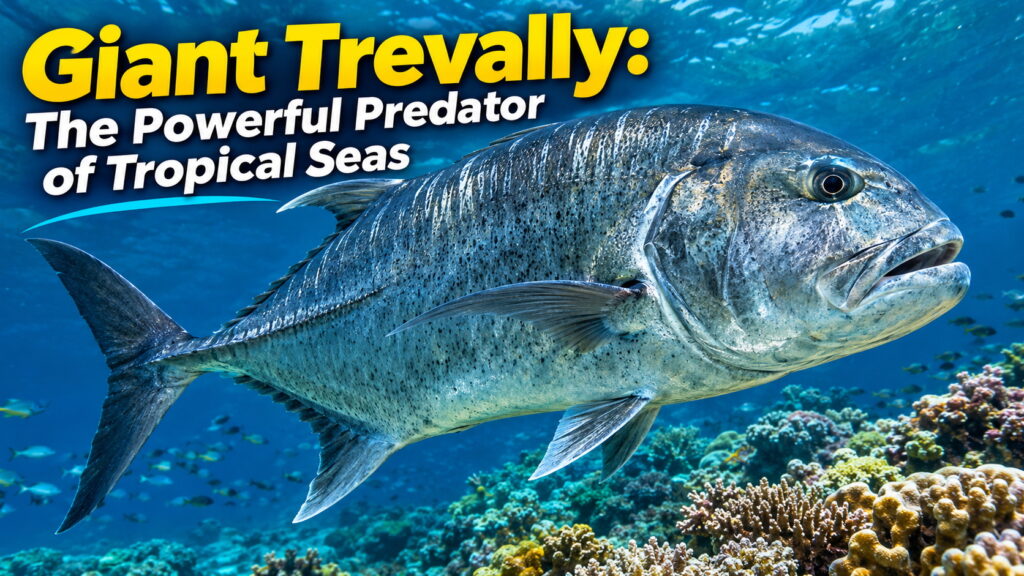
The giant trevally (Caranx ignobilis), commonly known as the GT, is one of the most powerful predatory fish in tropical oceans. With its muscular body, remarkable acceleration, and aggressive feeding behavior, this impressive species is an important hunter in coral reef and coastal ecosystems.


Giant Trevally Quick Facts
| Scientific Name | Caranx ignobilis |
|---|---|
| Family | Carangidae |
| Maximum Length | Approximately 170 cm |
| Maximum Published Weight | Approximately 80 kg |
| Distribution | Tropical Indo-Pacific |
| Habitat | Reefs, lagoons, coastal waters and estuaries |
| Diet | Fish, crustaceans and other marine animals |
1. Built for Strength and Speed
The giant trevally possesses a robust, streamlined body, powerful muscles, a steep forehead and a deeply forked tail. These features help it accelerate rapidly while pursuing prey.
Adult giant trevally typically display silvery-grey coloration, although some individuals become very dark or almost black. Their strong jaws allow them to capture and hold struggling prey.
Unlike many reef predators that depend heavily on camouflage, giant trevally are capable of pursuing prey through open water and around complex reef structures.
2. Natural Habitat and Distribution
Giant trevally are widely distributed throughout tropical regions of the Indian and Pacific Oceans. They inhabit waters around Southeast Asia, northern Australia, the Red Sea, the Indian Ocean and numerous Pacific islands.
Adults are commonly found around:
- Coral reef edges and channels
- Rocky coastal reefs
- Tropical lagoons
- Offshore banks and reef drop-offs
- Sandy and rocky coastal waters
Young giant trevally frequently occupy sheltered environments, including estuaries. As they grow, they increasingly use larger coastal and reef habitats.


3. Hunting Strategies of a Powerful Predator
The giant trevally is an opportunistic carnivore that feeds primarily on other fish, but its diet also includes crustaceans such as crabs and lobsters.
Its feeding behavior varies according to habitat, prey availability and environmental conditions.
High-Speed Pursuit
Powerful tail movements allow giant trevally to accelerate rapidly and chase smaller fish across reef environments.
Ambush Attacks
Giant trevally may use reef structures and underwater obstacles to approach prey before launching sudden attacks.
Opportunistic Feeding
These predators exploit situations in which smaller marine animals become concentrated or vulnerable, including around reef channels and coastal shallows.
Hunting Above the Water
One of their most unusual documented behaviors is leaping from the water to capture low-flying seabirds. Although remarkable, this behavior is not their primary method of feeding.
4. Behavior and Social Life
Large giant trevally are frequently encountered alone, but the species can also gather in groups, particularly during certain feeding or reproductive activities.
Juveniles may form schools, which can provide advantages while moving through coastal environments.
Adult giant trevally often patrol reef edges and channels, where currents and reef structure create opportunities for finding food.


5. Reproduction and Life Cycle
Giant trevally reproduce by releasing eggs and sperm into the water during spawning events. Spawning may occur around shallow outer reefs and offshore banks.
After hatching, young fish develop through early life stages before recruiting into suitable coastal habitats. Juveniles can use sheltered waters and estuaries, while older individuals increasingly occupy reef environments.
This life cycle highlights the importance of protecting interconnected marine habitats rather than focusing on coral reefs alone.
6. Importance in Marine Ecosystems
As large predatory fish, giant trevally play an important role in tropical marine food webs. By consuming smaller fish and crustaceans, they participate in the complex predator-prey relationships that help shape reef communities.
The presence of large predators can be an important component of healthy marine ecosystems, although their ecological effects vary among habitats.
Fishing pressure, habitat damage and declining coastal ecosystem quality can affect giant trevally populations locally.
7. Fascinating Giant Trevally Facts
- Impressive size: Giant trevally can reach approximately 1.7 meters in total length.
- Exceptional strength: Their muscular bodies make them highly prized by recreational anglers.
- Color variation: Some adults become nearly black.
- Flexible hunting: They can pursue prey, launch sudden attacks and exploit unusual feeding opportunities.
- Coastal adaptability: Different life stages occupy estuaries, lagoons and reef environments.
- Food safety: Large individuals in some regions can accumulate ciguatoxins and may be unsafe to eat.
Conclusion
The giant trevally is one of the most impressive predators found in tropical marine ecosystems. Its combination of power, rapid acceleration and adaptable hunting behavior makes it a remarkable example of life in the ocean.
From sheltered coastal nurseries to expansive coral reefs, the giant trevally demonstrates how marine predators depend on interconnected habitats throughout their lives.
Understanding and protecting these environments is important for maintaining the diverse marine life of tropical seas.
References and Further Reading
Image credits: Bernard DUPONT (CC BY-SA 2.0), NOAA / Dr. Dwayne Meadows (public domain), and Elias Levy (CC BY 2.0). Original images have been displayed responsively without intentional visual alteration.