


Views: 21
Oceanic Whitetip Shark: Life in the Open Ocean
Far beyond coastal reefs, one of the ocean’s most recognizable predators patrols the vast blue waters. The oceanic whitetip shark (Carcharhinus longimanus) is a powerful, wide-ranging shark adapted to surviving in the open ocean, where food is unpredictable and shelter is almost nonexistent.


Meet the Oceanic Whitetip Shark
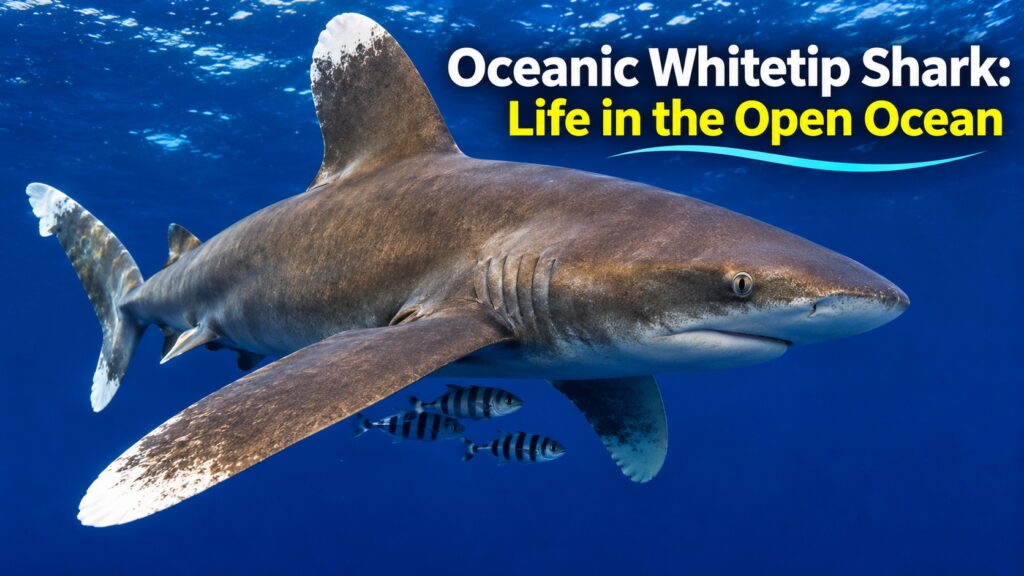
The oceanic whitetip belongs to the requiem shark family, Carcharhinidae. It is named for the characteristic white markings on its broad, rounded fin tips.
Its body is robust yet streamlined, with a broad snout, large pectoral fins and a powerful tail. These features help the shark travel through large expanses of water while searching for prey.
Once widespread and abundant in tropical offshore environments, this species has undergone severe population declines and is currently classified as Critically Endangered by the International Union for Conservation of Nature (IUCN).
Oceanic Whitetip Shark Facts
| Scientific name | Carcharhinus longimanus |
|---|---|
| Family | Carcharhinidae |
| Habitat | Tropical and subtropical open oceans |
| Length | Commonly around 1.5–2.5 meters; larger individuals occur |
| Diet | Fish, squid and other marine animals |
| Distribution | Atlantic, Indian and Pacific Oceans |
| Reproduction | Live-bearing |
| Conservation status | Critically Endangered |
Built for Life in the Open Ocean
Unlike reef sharks that frequently navigate coral formations and coastal habitats, oceanic whitetips spend much of their time in offshore waters.
Their exceptionally long, rounded pectoral fins provide stability during sustained swimming. This is an important adaptation in an environment where finding food may involve traveling considerable distances.
The shark’s upper body is usually gray, bronze or brown, while its underside is lighter. The white or mottled tips of its fins are among the easiest ways to distinguish it from other large sharks.


How Oceanic Whitetip Sharks Hunt
Food is often widely scattered across the open ocean. Oceanic whitetips are opportunistic hunters capable of exploiting different sources of nutrition.
Their diet primarily consists of pelagic fish, including tuna and other offshore species, alongside squid. They may also consume rays, smaller sharks and carrion when available.
With their highly developed senses, oceanic whitetips can investigate potential food sources in seemingly empty stretches of water.
They sometimes associate with pilot fish, which swim close to the sharks and may feed on scraps or small organisms around them.
Where Do Oceanic Whitetip Sharks Live?
Oceanic whitetips occur across tropical and subtropical regions of the Atlantic, Indian and Pacific Oceans.
They generally favor warm offshore waters and are frequently encountered near the ocean surface. Although they spend substantial time in the upper water column, tracking research has shown that they are also capable of deep dives.
Some individuals migrate over long distances, emphasizing the importance of conservation efforts that extend beyond national boundaries.
Reproduction and Life Cycle
Oceanic whitetip sharks give birth to live young rather than laying eggs. Developing embryos are nourished within the mother’s body before birth.
Gestation lasts approximately one year, and litter sizes vary. A female may give birth to several pups, which are already capable of swimming and hunting independently.
Because these sharks mature relatively slowly and produce limited numbers of offspring, populations cannot recover quickly from excessive fishing pressure.
Why Are Oceanic Whitetip Sharks Endangered?
The greatest danger to oceanic whitetips comes from commercial fishing activity.
They are frequently caught as bycatch in longline fisheries targeting tuna and swordfish. Historical demand for shark fins has also contributed to population losses.
Their tendency to swim near the surface and investigate potential food sources increases their vulnerability to fishing equipment.
Population declines have been particularly severe in several ocean regions, leading to international concern about the species’ survival.
Protecting an Open-Ocean Predator
Oceanic whitetips benefit from conservation measures including fishing restrictions, international trade controls, improved fishing practices and scientific monitoring.
Reducing accidental shark catches is particularly important. Measures such as changing fishing gear, improving handling procedures and protecting important habitats may help lower mortality.
International cooperation is essential because these sharks routinely cross national and international waters.
Why Oceanic Whitetip Sharks Matter
As large predators, oceanic whitetips are important members of open-ocean food webs. Their feeding behavior influences interactions among different marine species.
Protecting them contributes to wider efforts to preserve ocean biodiversity and promote responsible fisheries management.
Final Thoughts
The oceanic whitetip shark is a remarkable survivor of the open ocean. Its powerful swimming ability, distinctive fins and opportunistic hunting behavior demonstrate how predators adapt to life far from shore.
Yet even a highly capable ocean predator is vulnerable to human activity. Protecting oceanic whitetips will require continued scientific research, effective fisheries management and international conservation cooperation.