


Views: 0
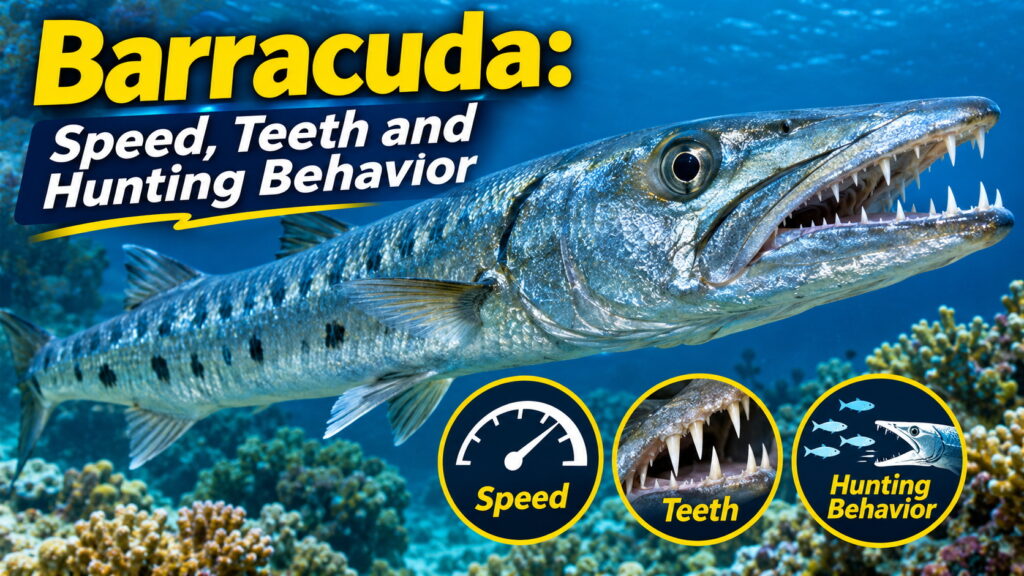
Barracuda: Speed, Teeth and Hunting Behavior


The barracuda is one of the ocean’s most impressive predatory fish, famous for its extraordinary bursts of speed, razor-sharp teeth, and efficient hunting techniques. With a streamlined body and powerful jaws, this marine predator is perfectly adapted to capturing fast-moving prey.
Barracudas inhabit tropical and subtropical waters around the world. The great barracuda (Sphyraena barracuda) is among the most recognizable species, reaching lengths exceeding 1.5 meters.
Quick Facts About Barracudas
| Scientific Family | Sphyraenidae |
|---|---|
| Notable Species | Great barracuda |
| Scientific Name | Sphyraena barracuda |
| Habitat | Tropical and subtropical oceans |
| Estimated Maximum Speed | Up to 58 km/h (36 mph) in short bursts |
| Diet | Fish, squid, and occasionally crustaceans |
| Hunting Strategy | Ambush and rapid pursuit |
| Behavior | Often solitary as large adults |
1. Built for Incredible Speed
Barracudas have long, slender bodies that reduce resistance as they move through the water. Their powerful tails and rear-positioned dorsal and anal fins help them accelerate rapidly while maintaining stability.
The great barracuda is commonly estimated to reach speeds of approximately 58 km/h (36 mph) during short bursts. This figure should be understood as an estimate rather than a precisely established sustained swimming speed.
Instead of pursuing prey over long distances, barracudas often depend on explosive acceleration. They can remain nearly motionless before suddenly launching an attack.
Physical Adaptations for Speed
- Streamlined body: Minimizes water resistance.
- Powerful tail: Provides rapid propulsion.
- Rear-positioned fins: Support stability during fast movements.
- Strong muscles: Produce short bursts of acceleration.
- Excellent vision: Helps locate prey before attacking.
2. Razor-Sharp Teeth and Powerful Jaws


One of the barracuda’s most distinctive features is its mouth, which contains numerous sharp teeth designed for gripping and cutting prey.
Great barracudas have smaller cutting teeth and larger fang-like teeth. Some of the longer teeth fit into spaces in the opposite jaw when the mouth closes.
These specialized teeth allow barracudas to seize slippery fish and sometimes slice larger prey into smaller pieces.
3. Hunting Behavior: Speed Meets Strategy
Barracudas are skilled visual predators that combine patience with explosive speed.
Unlike predators that rely exclusively on prolonged pursuit, barracudas frequently use an ambush strategy. They remain relatively still, observe the movements of nearby fish, and attack when a suitable opportunity appears.
How Barracudas Hunt
- Observation: The barracuda watches potential prey while remaining relatively motionless.
- Positioning: It approaches or waits until the fish enters striking range.
- Sudden acceleration: It launches forward with a powerful burst of speed.
- Capture: Its sharp teeth seize the prey and prevent escape.
- Feeding: Smaller fish may be swallowed whole, while larger prey can be cut into pieces.
Great barracudas feed primarily on other fish, including mullets, snappers, groupers, and various reef species.
4. Where Do Barracudas Live?

