


Views: 0
Arapaima: The Giant Air-Breathing Fish of the Amazon
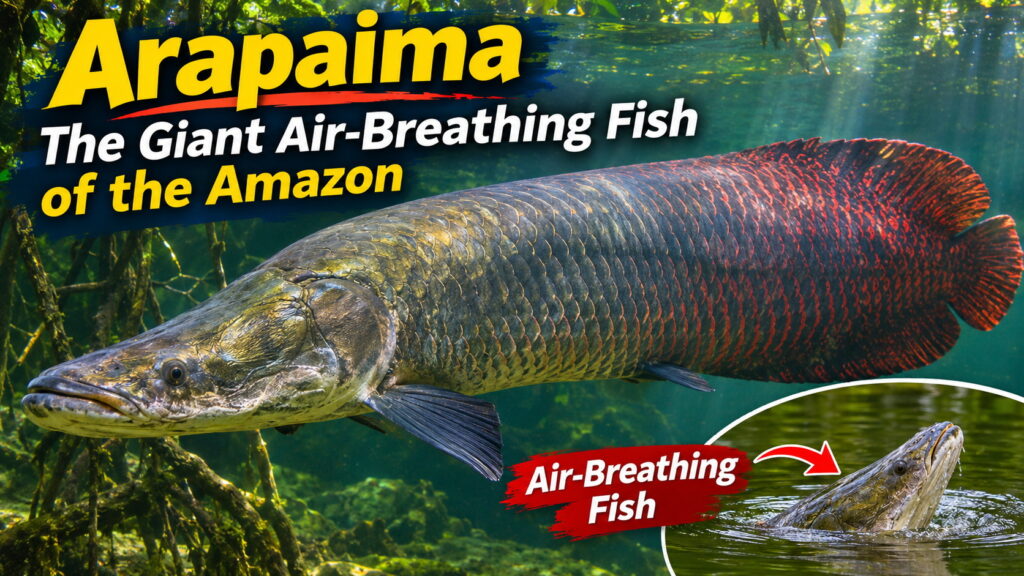
Deep within the vast waterways of the Amazon River basin lives one of the most extraordinary freshwater fish on Earth: the arapaima (Arapaima gigas). Known as pirarucu in Brazil and paiche in Peru, this enormous fish is famous for its remarkable size, powerful body, protective scales, and unusual ability to breathe atmospheric air.
Reaching lengths of around 3 meters (10 feet) in exceptional cases, the arapaima ranks among the largest freshwater fish in the world. Its evolutionary adaptations allow it to survive in aquatic environments where many other fish struggle.


Quick Facts About the Arapaima
| Feature | Details |
|---|---|
| Scientific name | Arapaima gigas |
| Other names | Pirarucu, Paiche |
| Family | Arapaimidae |
| Habitat | Amazonian rivers, lakes and floodplains |
| Exceptional length | Around 3 meters or more |
| Reported weight | Up to approximately 200 kg |
| Diet | Primarily fish |
| Breathing | Obligate air-breather |
| Lifespan | Approximately 15–20 years |
1. A Giant Among Freshwater Fish
The arapaima has a long, streamlined body, a broad head and a powerful tail. Its large scales are often grayish or greenish toward the front of the body, with striking reddish markings near the rear.
Although arapaima are commonly described as reaching enormous sizes, not every adult becomes a three-meter giant. Most individuals are smaller, and the largest reported measurements should be treated as exceptional.
Its impressive body gives it the strength to move through rivers, shallow lakes and flooded forests while searching for prey.


2. How Does the Arapaima Breathe Air?
One of the arapaima’s most remarkable characteristics is its ability to breathe oxygen directly from the atmosphere.
Unlike most fish, which depend primarily on oxygen dissolved in water, the arapaima possesses a highly modified, vascularized swim bladder that functions as an air-breathing organ.
The fish must regularly rise to the surface to gulp air, often at intervals of approximately 10–20 minutes, although the frequency varies with activity and environmental conditions.
Why Is Air Breathing Important?
Many Amazonian waters are warm and contain relatively little dissolved oxygen. Flooded forests and decomposing vegetation can further reduce oxygen availability.
The arapaima’s ability to obtain oxygen from the atmosphere provides a significant advantage in these challenging environments.
Interesting fact: An arapaima cannot survive indefinitely underwater without access to atmospheric air. Surfacing is an essential part of its normal respiration.
3. Hunting and Feeding Behavior
The arapaima is a powerful carnivorous fish that feeds mainly on other fish. Depending on its age, location and prey availability, it may also consume crustaceans, insects and other small animals.
One of its most effective feeding methods is suction feeding. The arapaima rapidly opens its mouth, creating a flow of water that draws nearby prey inside.
Its relatively large mouth and muscular body make it an effective hunter in freshwater environments.
How Does It Capture Prey?
- Detection: The fish identifies potential prey in the surrounding water.
- Approach: It moves toward the target, sometimes using sudden bursts of speed.
- Suction: Rapid mouth expansion pulls prey inward with water.
- Swallowing: Its powerful jaws and internal mouth structures help handle captured prey.
4. Armor-Like Scales: Nature’s Protective Design
The arapaima’s scales are among its most impressive physical features. They combine a hard outer mineralized layer with a flexible collagen-rich structure underneath.
This arrangement helps the scales resist punctures while allowing the fish to bend and swim naturally.
Scientists have studied arapaima scales because their layered construction may inspire the development of stronger, lightweight protective materials.


5. Reproduction and Parental Care
Arapaima have an unusual reproductive strategy compared with many other freshwater fish. Rather than simply releasing eggs and abandoning them, adults provide care for their offspring.
Breeding typically occurs in shallow water, where the fish prepare nest-like depressions in the substrate.
After the eggs hatch, the parents help protect the developing young, with males playing a particularly important role in guarding the offspring.
This parental care can improve the chances that young arapaima survive during their vulnerable early stages.
6. Life in the Amazon Rainforest
The Amazon basin contains a vast network of rivers, lakes, wetlands and seasonally flooded forests. These habitats provide food, shelter and breeding opportunities for arapaima.
During the rainy season, rising water can spread across forested floodplains, giving fish access to new feeding areas.
When water levels decline, arapaima become more concentrated in deeper lakes and permanent waterways.
Their life cycle is closely connected to these seasonal fluctuations, making healthy floodplain ecosystems essential for their long-term survival.


7. Conservation Challenges
For generations, arapaima have been an important source of food and income for communities living throughout the Amazon basin.
Unfortunately, their enormous size and frequent surfacing behavior can make them particularly vulnerable to fishing pressure.
Overfishing has caused substantial local declines in some regions. However, community-based fisheries management has demonstrated that populations can recover when harvesting is carefully regulated.
How Can Arapaima Be Protected?
- Protecting lakes, rivers and floodplain habitats.
- Enforcing responsible fishing regulations.
- Supporting community-managed fisheries.
- Monitoring local populations and breeding areas.
- Encouraging sustainable use of Amazonian aquatic resources.
Conservation status requires careful interpretation because population conditions differ across the Amazon basin. Arapaima gigas has been assessed globally as Data Deficient by the IUCN, even though some local populations face serious fishing pressure.
8. Ten Fascinating Facts About the Arapaima
- The arapaima is one of the largest freshwater fish on Earth.
- It must regularly surface to breathe atmospheric air.
- Its modified swim bladder functions as a respiratory organ.
- It can survive in waters containing very little dissolved oxygen.
- Its scales possess a remarkable layered protective structure.
- It primarily hunts other fish.
- It uses powerful suction feeding to capture prey.
- Adults provide parental care to their offspring.
- Its reproduction is influenced by seasonal changes in Amazonian water levels.
- Community fisheries management has helped recover populations in some Amazonian regions.
Frequently Asked Questions About the Arapaima
Is the arapaima the largest freshwater fish in the world?
The arapaima is among the largest freshwater fish, but it is not universally recognized as the largest. Other species, including giant freshwater stingrays, can reach greater documented weights.
Can an arapaima breathe outside water?
The arapaima breathes atmospheric air, but it remains an aquatic animal. It must stay in suitable water to maintain normal body function and survive.
Is the arapaima dangerous to humans?
Arapaima are powerful wild fish, and large individuals can cause injuries if handled carelessly. However, humans are not their normal prey.
What does the arapaima eat?
Its diet consists primarily of fish, although it may eat other small animals depending on food availability.
Where can arapaima be found?
Arapaima are native to parts of the Amazon basin in South America. They have also been introduced to some locations outside their native range.
Conclusion: A Remarkable Giant of the Amazon
The arapaima is one of the most fascinating inhabitants of South America’s freshwater ecosystems. Its enormous size, air-breathing ability, protective scales and distinctive parental behavior make it a remarkable example of adaptation to life in the Amazon.
Beyond its biological importance, the arapaima is also closely connected to the livelihoods and traditions of Amazonian communities.
Protecting this remarkable fish means supporting sustainable fisheries and preserving the extraordinary aquatic environments that make the Amazon one of the richest ecosystems on Earth.
References and Further Reading
- Smithsonian National Zoo – Arapaima
- FishBase – Arapaima gigas
- IUCN Red List – Arapaima gigas
- Wikimedia Commons – Arapaima Photographs
Image licensing note: Photographs are credited individually. Creative Commons attribution and share-alike conditions apply where indicated. No photographic modifications are indicated.