
Views: 0
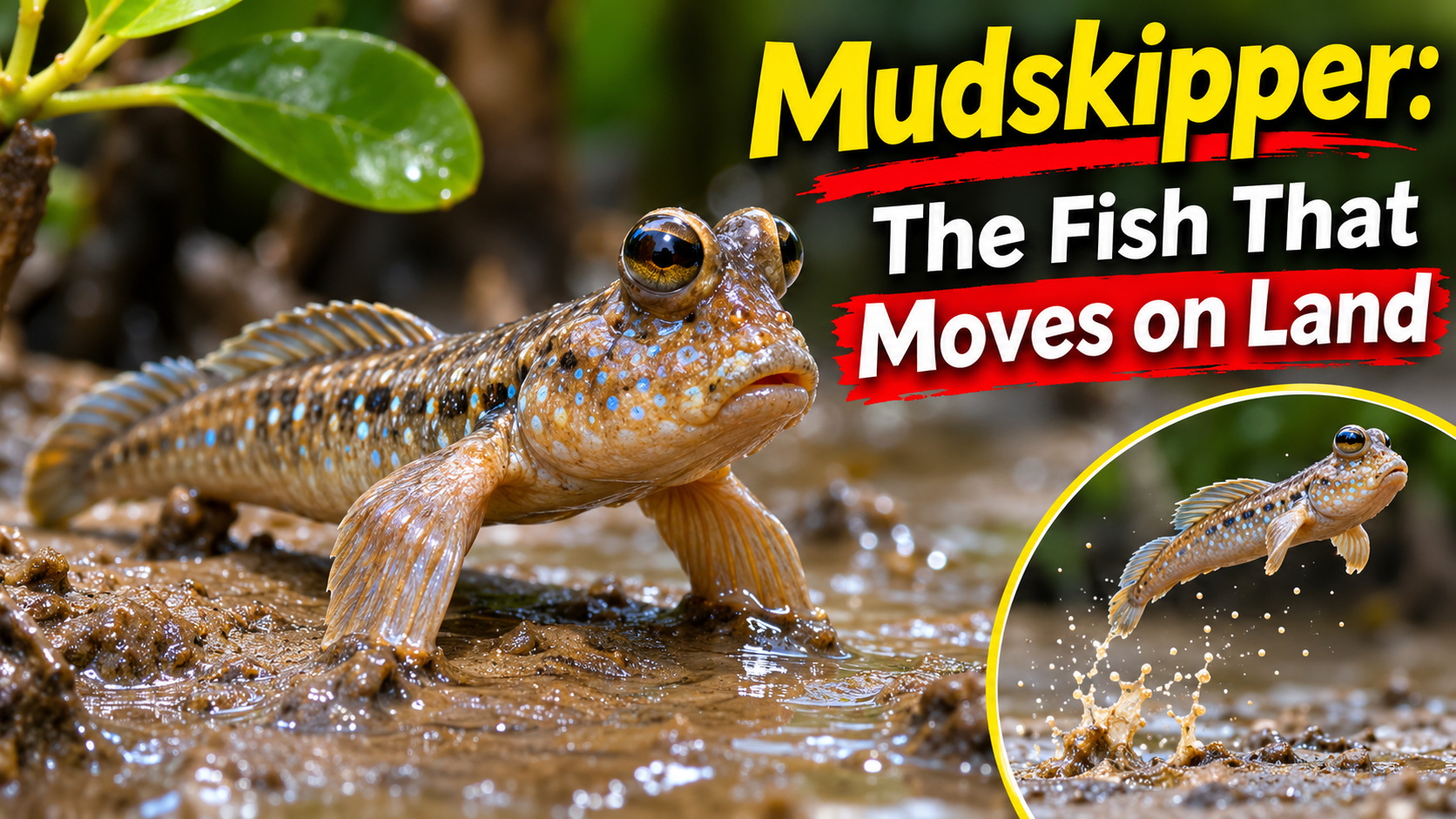
Imagine a fish that can leave the water, travel across muddy ground, climb roots, and leap into the air. Meet the mudskipper, one of nature’s most extraordinary amphibious fish.
Unlike most fish, mudskippers are specially adapted to spend significant periods outside water. Their powerful fins, prominent eyes, and unusual breathing abilities allow them to survive in challenging coastal habitats.

What Is a Mudskipper?
Mudskippers are specialized members of the goby family, Gobiidae. They inhabit intertidal environments where land is regularly covered and exposed by changing tides.
These unusual fish are found in tropical and subtropical coastal regions, particularly around mangrove forests, estuaries, and mudflats in Africa, Asia, and the Indo-Pacific region.
| Common Name | Mudskipper |
|---|---|
| Animal Group | Fish |
| Family | Gobiidae |
| Habitat | Mangroves, mudflats, estuaries |
| Distribution | Tropical and subtropical coastal regions |
| Diet | Small invertebrates, algae and other food depending on species |
| Special Abilities | Air breathing, movement on land, jumping and climbing |
How Do Mudskippers Move on Land?
The mudskipper’s most famous characteristic is its ability to move across exposed mud. Instead of walking with legs, it uses its strong pectoral fins to support and propel its body.
This movement is often called crutching. The fish plants its pectoral fins against the ground and pushes its body forward.
Mudskippers can also perform impressive jumps. By bending and rapidly straightening their bodies and tails, they propel themselves through the air.
Some species can climb low vegetation, exposed mangrove roots, and other suitable surfaces. These abilities help them explore their habitats, escape danger, and interact with other mudskippers.

How Can Mudskippers Breathe Outside Water?
Most fish rely on water passing over their gills to obtain oxygen. Mudskippers have developed additional adaptations that allow them to breathe while outside water.
One important adaptation is cutaneous respiration, which means absorbing oxygen through the skin.
Their skin must remain moist for efficient gas exchange. Mudskippers can also retain water within their enlarged gill chambers, helping their respiratory structures continue functioning outside water.
These adaptations do not make mudskippers independent of water. They still require moist environments and can become stressed or dehydrated when conditions are too dry.
Why Do Mudskippers Have Bulging Eyes?
Mudskippers have distinctive, protruding eyes positioned high on their heads.
This arrangement provides a wide field of vision and allows them to watch their surroundings while the rest of their bodies remain close to the mud.
Their eyes help them detect predators, find food, and observe rivals. Mudskipper vision is also specialized for use in air, making it particularly useful during their terrestrial activities.
What Do Mudskippers Eat?
Mudskippers have varied diets depending on their species, body size, and habitat.
Some species actively hunt insects, worms, and small crustaceans, while others feed on algae, diatoms, and organic material associated with muddy surfaces.
Their ability to forage on exposed mudflats gives them access to food resources that are less accessible to fully aquatic fish.

Burrows and Territorial Behavior
Many mudskippers construct burrows in soft coastal sediment. These shelters provide protection from environmental changes and potential predators.
Burrows can also play an important role in reproduction.
Mudskippers may defend territories around their burrows. Males of some species display their dorsal fins, perform jumps, and engage in visual displays when competing with rivals or attracting females.
How Do Mudskippers Reproduce?
Reproductive behavior varies among mudskipper species.
In some species, males maintain breeding burrows containing chambers where females deposit eggs.
Because oxygen can be limited inside waterlogged sediments, certain mudskippers transport and maintain air inside their burrow chambers to support egg development.
These behaviors demonstrate the complex adaptations required to reproduce in tidal environments.
Why Are Mudskippers Important?
Mudskippers are part of the intricate food webs of coastal wetlands. They consume small organisms and serve as prey for larger animals.
Their feeding and burrowing activities also contribute to biological interactions within muddy habitats.
Scientists study mudskippers to understand amphibious locomotion, respiration, vision, and the adaptations that allow vertebrates to function outside water.
Although mudskippers are not the ancestors of modern land vertebrates, their biology provides useful comparisons for investigating the challenges of living between water and land.
Threats to Mudskippers
Mudskippers depend on functioning coastal wetlands, and habitat changes can threaten their survival.
- Destruction of mangrove forests
- Coastal development and land reclamation
- Water and sediment pollution
- Alteration of natural tidal flows
- Degradation of estuaries and mudflats
Protecting coastal ecosystems is important not only for mudskippers but also for the many other species that depend on mangroves and intertidal environments.
Fascinating Mudskipper Facts
- Mudskippers are true fish, not amphibians.
- They can breathe through their moist skin.
- Their powerful pectoral fins help them move across land.
- Some species can jump and climb exposed roots.
- Their elevated eyes allow them to observe activity above the mud.
- Some mudskippers maintain air pockets in breeding burrows.
- Their behavior changes with the tides and environmental conditions.
Conclusion
The mudskipper is a remarkable example of evolutionary adaptation. Its powerful fins, unusual respiratory abilities, specialized eyes, and complex behavior allow it to thrive in environments where water and land constantly meet.
By studying mudskippers, researchers gain valuable insights into how animals overcome the physical challenges of life outside water. These fascinating fish also remind us of the importance of preserving mangroves, estuaries, and the world’s coastal wetlands.
Image Credits and Further Reading
Photographs are credited individually beneath each image. Original files and licensing information: