
Views: 1
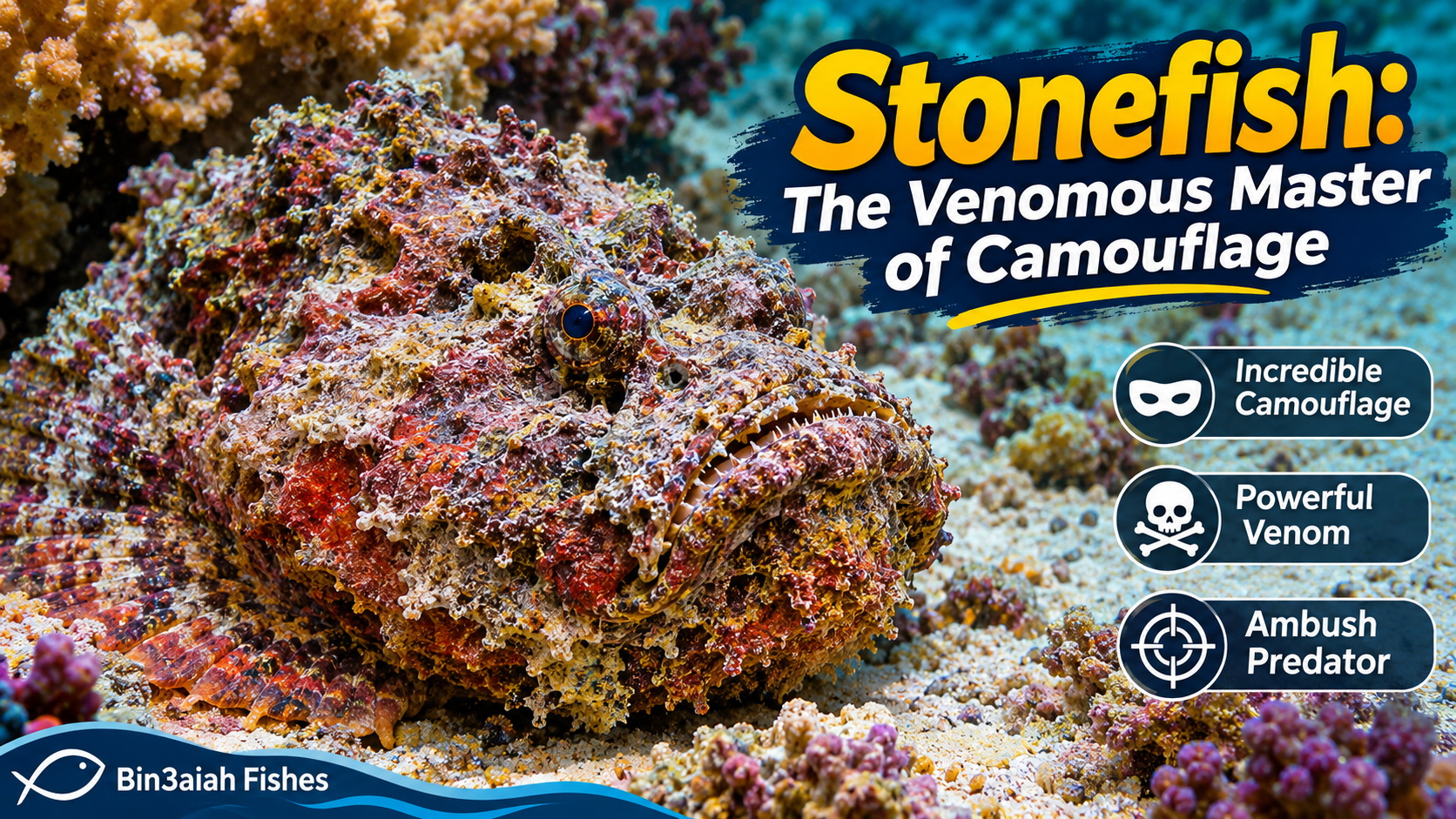
Stonefish: The Venomous Master of Camouflage
Hidden among coral reefs and rocky seabeds lives one of the ocean’s most extraordinary predators: the stonefish. Famous for its incredible camouflage and powerful venom, this unusual fish is perfectly adapted to life on the ocean floor.

Stonefish: Quick Facts
| Scientific Name | Synanceia verrucosa (reef stonefish) |
|---|---|
| Family | Synanceiidae |
| Habitat | Coral reefs, rocky bottoms and sandy seabeds |
| Distribution | Tropical Indo-Pacific |
| Typical Maximum Length | Approximately 35 cm |
| Diet | Small fish and crustaceans |
| Defense | 13 venomous dorsal-fin spines |
1. A Master of Underwater Camouflage
The stonefish is one of the most convincing examples of camouflage in the marine world. Its rough skin, irregular shape and mottled brown, gray and sometimes reddish coloration make it resemble a rock or an encrusted piece of coral.
This remarkable disguise allows the fish to remain almost invisible to passing animals. Rather than chasing prey, the stonefish waits patiently until a suitable target approaches.
Some stonefish also develop algae and other marine growth on their bodies, further improving their natural concealment.

2. One of the World’s Most Venomous Fish
Stonefish are widely regarded as among the most venomous fish in the world. The reef stonefish possesses 13 strong dorsal-fin spines capable of delivering venom when pressure is applied.
These spines serve primarily as a defensive mechanism. If a predator attacks or a person accidentally steps on the fish, the spines can puncture the skin and inject venom.
Stonefish venom can cause extreme pain, swelling and tissue damage. Severe cases may involve broader effects on the body, making prompt medical treatment essential.
Important: Stonefish do not normally attack humans. Most injuries occur when people accidentally touch or step on a concealed fish.
3. How Stonefish Hunt Their Prey
Unlike fast-moving hunting fish, stonefish rely on an ambush strategy.
They remain almost completely motionless on the seabed, waiting for small fish or crustaceans to pass nearby. Once prey enters striking distance, the stonefish rapidly opens its large mouth and creates suction that pulls the animal inside.
The attack is extremely fast, allowing the predator to capture prey before it can escape.
Interestingly, stonefish do not need their venom to capture food. Their dorsal spines are mainly used for defense, while their powerful suction-feeding mechanism handles hunting.
4. Habitat and Distribution
Reef stonefish inhabit tropical marine environments throughout the Indo-Pacific region, including the Red Sea and parts of the Indian and Pacific Oceans.
They are commonly associated with coral reefs, shallow rocky seabeds, lagoons and areas containing sand or coral rubble.
Their ability to blend into the seafloor makes them difficult to detect, even in relatively clear water.

5. What Happens If a Stonefish Stings You?
A stonefish sting can produce immediate and severe pain. Other symptoms may include swelling, redness and tissue injury, while serious envenomation can cause additional complications.
If a stonefish sting is suspected:
- Leave the water immediately and move to safety.
- Seek urgent medical assistance.
- While arranging medical help, immerse the affected area in hot, non-scalding water, ideally around 45°C if safely tolerated, to help reduce pain.
- Do not cut the wound, attempt to suck out venom or use a tourniquet.
- Do not attempt to remove deeply embedded spines yourself.
Doctors may provide pain relief, wound treatment and, in selected serious cases, stonefish antivenom.
Safety reminder: Hot-water immersion is a first-aid measure, not a replacement for emergency medical care. Avoid water hot enough to burn the skin.
6. Natural Predators and Ecological Importance
Despite their impressive defenses, stonefish are not completely protected from predators. Some sharks, rays and sea snakes have been documented preying on them.
Stonefish also play a role in marine food webs by feeding on smaller fish and crustaceans.
Their specialized hunting behavior and camouflage make them valuable examples of how marine animals adapt to their environments.
7. Fascinating Stonefish Facts
- Exceptional camouflage: Stonefish can closely resemble rocks and coral.
- Venomous defense: Reef stonefish have 13 venom-delivering dorsal-fin spines.
- Rapid feeding: They use extremely fast suction attacks to capture prey.
- Patient hunters: They often remain stationary for long periods.
- Tropical distribution: Reef stonefish live across a broad area of the Indo-Pacific.
- Dangerous when disturbed: Accidental contact is a major cause of human stings.
Conclusion
The stonefish is a fascinating demonstration of nature’s ability to combine concealment, patience and powerful defense.
Although its venom makes it potentially dangerous, the stonefish is not an aggressive hunter of humans. It is a highly specialized marine predator whose unusual appearance and remarkable adaptations have helped it survive in tropical ocean environments.
Understanding these fish encourages greater appreciation for marine biodiversity and safer behavior around coral reefs and shallow coastal waters.